
The 10 Greatest Mind-Altering Drugs and Drinks in Science Fiction
 |
By Patrick Cooper
Face it folks, the future is a scary, panic attack-inducing place. Think of the technology that existed 10 years ago and look at what we have now (or just look at contemporary Tokyo). Scifi has always reflected these changes on a social and cultural level and along this plane of logic, drugs and alcohol are moving at the same pace. While most real drugs ensure users a good time and an imminent morning of shame and douche chills, drugs in scifi help navigation, bring about telepathic abilities, reveal the true nature of the government, or just split your brain in half while you trip balls. Sometimes the dealers are young kids or members of resistance movements, but most of the time it’s the suits in seats of power manufacturing the goods. Either way, here’s the 10 greatest drugs from scifi literature and celluloid. Unfortunately these are fictional so no field research was possible to back the selections up. Pass the Soma and enjoy.
10) Stelazine from Philip K. Dick’s Faith of Our Fathers
A recurring theme in science fiction is the distribution of drugs by the government to keep citizens docile. Counter-culture sci-fi icon Philip K. Dick used the theme in his work frequently — his own drug use is often mythologized. In the infamous 1967 anthology Dangerous Visions, editor Harlan Ellison stated that Dick was under the influence of LSD when he wrote his contribution, the terrifying “Faith of Our Fathers.” Dick later refuted this in his novel Radio Free Albemuth, stating: “After that I had a really dreadful reputation as a doper, thanks to Harlan’s desire for publicity. Later on I was able to add a paragraph to the afterword of the story stating that Harlan had not told the truth, but the harm was done.” The story takes place in Vietnam, where the atheist Communist Party drugs the water supply with hallucinogens to keep the real appearance of the Party leader a secret. Tung Chien, a party bureaucrat, is given an anti-hallucinogen by a resistant movement. The drug, stelazine, allows Chien to see one of the real forms of the leader; gnashing metal teeth and all. Dick would revisit all of these themes in his later works and so will you further down this list.
9) Glitterstim from Star Wars
All we know about “spice” and its specific variety “Glitterstim” from the OT is that Han’s fumbled transport of it earned him a death mark from Jabba. The Extended Universe elaborates on the drug and we learn that its effects include a temporary telepathic ability and state of euphoria. Overuse leads to nerve damage, loss of sight, and paranoia. Glitterstim is produced from the web of Energy Spiders (seen above) who inhabit the spice mines of Kessel, where Han and Chewie first meet. Han himself was a user and the spice makes several EU appearances, most recently in the Aaron Allston novel Outcast.
8) Dust from Babylon 5
What do you get when you mix Babylon 5 with Homicide: Life on the Street? Answer: The Babylon season 3 episode “Dust to Dust.” After Narn ambassador G’Kar uses the drug Dust to telepathically assault Ambassador Mollari, Psi Cop Bester is sent to Babylon 5 to find the dealer. Dust gives non-telepaths the ability to invade the minds of others; experiencing their thoughts and memories along the way. The catch is that the victims are left unconscious and telepathic victims never really recover. Narns used to have telepathic abilities, but this was lost after the majority of Narn families were wiped out and the telepathic gene eventually faded away. Dust, however, allows the user to temporarily regain this ability. Bester eventually reveals that Dust was originally manufactured by Psi Corps in an attempt to develop human telepaths. The theme of human telepaths would later be revisited by director Nancy Meyers in her sci-fi epic What Women Want.
7) Can-D and Chew-Z from Philip K. Dick’s The Three Stigmata of Palmer Eldritch
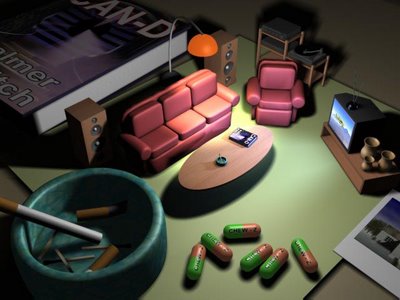
While the drug of choice for author Philip K. Dick ran the gamut of uppers, his 1965 Nebula-nominated novel The Three Stigmata of Palmer Eldritch featured two distinct hallucinogens: Can-D and Chew-Z. Can-D is used by colonists to “translate” themselves into the Barbie-style “Perky Pat” layouts where they either become Perky Pat or her boyfriend, Walt. While in this shared-hallucination, users can leave behind their dismal existence and act out an idealized, “swell” version of life on Earth. P.P. Layouts, the company behind Perky Pat, is also the manufacturer of the “illegal” Can-D. P.P. gets some competition when Palmer Eldritch is rescued from a crash on Pluto and returns with an alien drug known as Chew-Z. Like Can-D, Chew-Z transports the user into an alternate reality but the difference is that Eldritch plays puppet master to these hallucinations. The book spirals in and out of reality and hellish hallucinations until the memorable last trip.
6) Nuke from Robocop II
The inferior sequel to Paul Verhoeven’s classic saw Robocop squaring off against a drug cartel led by Cain, a balding misanthrope in a Salvation Army leather-vest. In near-dystopian Detroit, the designer-drug of choice is Nuke which comes in a quasi-ketchup packet you squeeze straight into your bloodstream. Not only will it make a crazy noise when administered, but the person you bought it from is probably 10-years old, asshole. In Cain’s perpetual ketchup-haze, he believes that Nuke is the key to paradise. After Cain tortures a cop to death (is there any other way to get information?), he fatally beefs with Robocop and gets his ass handed to him. OCP psychologist Dr. Juliette Faxx transfers Cain’s brain to a new cyborg, Robocop 2 — doy — and a sweet deal between mayor, police, and drug dealers is made; ensuring Cain’s heirs that they’ll have immunity to distribute in Old Detroit. Being a true testament to the junkie condition, not even cyborg-Cain cannot resist Nuke and Robocop uses Cain’s addiction to distract him, punching a hole through his cyborg shell right to his brain. And that my friends, is symbolism, Irvin Kershner-style.
—-
5) Substance D from Philip K. Dick’s A Scanner Darkly
Hat trick for Philip K. Dick! Derived from the small blue flower “Mors ontologica,” Substance D (or “Slow Death,” “Death,” or “D”) is a highly addictive psychoactive drug which causes the two hemisphere’s of the user’s brain to act independently. Sounds like the absolute worst Friday night. D comes from Dick’s semi-autobiographical novel A Scann
er Darkly, in which narcotics agent Fred is investigating junkie Bob Arctor. But because of Fred’s own use of D, he doesn’t realize that he is Bob. Eventually Fred discovers the truth and is sent to a rehab program called New Path, which is secretly the producer and distributor of D. You know, like how the U.S. government introduced crack to the inner cities in the ’80s. Above is the trailer for the 206 adaptation by Richard Linklater, the most faithful Dick adaption to date.
4) Soma from Aldous Huxley’s Brave New World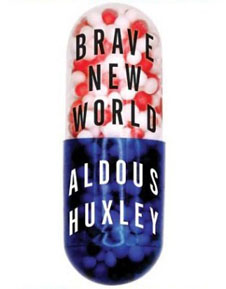
“All the advantages of Christianity and alcohol; none of their defects.” In the year of Our Ford 632, the World State uses the hallucinogenic designer-drug Soma as a method of control and as a mass tranquilizer. Soma sends its users on a hangover-free “vacation” and like melange, Soma is used for several purposes including relaxation, confidence and during the religious gatherings known as “Solidarity Services.” However, unlike the life-altering melange, Soma is more of an opiate that induces a false happiness. Sometimes the effect isn’t strong enough like in the case of John the Savage who commits suicide after taking Soma. With about 68 million Americans using Paxil, Prozac, or Zoloft, the idea of Soma may have been Huxley’s most prophetic vision. Now where did I hide that gin?
3) The Pan-Galactic Gargle Blaster from Douglas Adams’ Hitchhiker’s Guide to the Galaxy
The Pan-Galactic Gargle blaster is the Perfect Storm of booze. Under “alcohol” in the Hitchhiker’s Guide to the Galaxy, the “Best Drink in Existence” is listed as the Pan-Galactic Gargle Blaster. It was created by our favorite two-headed president playboy, Zaphod Beeblebrox (who is also the only person who can drink three of them in one sitting), and is described as “the alcoholic equivalent to a mugging; expensive and bad for the head.” The recipe provided in the Guide goes as follows:
? Take the juice from one bottle of that Ol’ Janx Spirit.
? Pour into it one measure of water from the seas of Santraginus V
? Allow three cubes of Arcturan Mega-gin to melt into the mixture (it must be properly iced or the benzene is lost).
? Allow four litres of Fallian marsh gas to bubble through it (in memory of all those happy Hikers who have died of pleasure in the Marshes of Fallia).
? Over the back of a silver spoon float a measure of Qualactin Hypermint extract, redolent of all the heady odours of the dark Qualactin Zones.
? Drop in the tooth of an Algolian Suntiger. Watch it dissolve, spreading the fires of the Algolian suns deep into the heart of the drink.
? Sprinkle Zamphour.
? Add an olive.
? Drink…but very carefully.
Douglas Adams once said that “there are a number of environmental and weapons treaties, as well as laws of physics, which prevent the Pan-Galactic Gargle Blaster from being mixed on Earth.” Mr. Adams, you thought up the most incredible alcoholic drink in the history of the universe and despite the warnings, we would still all love to have one; toasting in your memory before we hit the floor.
2) The Formula from H.G. Wells’ The Invisible Man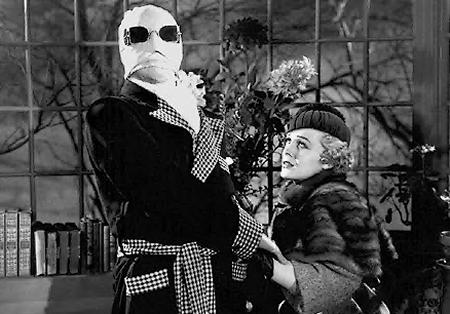
In Wells’ 1897 classic, unfortunate albino medical student Griffin experiments with a formula to alter the refractive index of objects, causing them to turn invisible. Griffin originally experiments on a neighbor’s cat, but once the cat’s owner complains to the landlord, Griffin performs the procedure on himself. Better than paying rent, I suppose. The only thing visible about Griffin is the clothes he wears and the food he digests. After burning down his house and stealing money from his dad (causing him to commit suicide), Griffin hides out at The Coach and Horse inn. There he attempts to reverse the procedure, but is unsuccessful, gradually leading to his insanity. Batshit Griffin rants about the Reign of Terror (The First Year of the Invisible Man) and is eventually beat to death by the locals while chasing his first victim. This parable of moral evaporation brought upon by invisibility originated in Plato’s “Ring of Gyges” and even influenced the One Ring 50 years later. Let’s just pretend Verhoeven’s Hollow Man never happened.
1) Melange from Frank Herbert’s Dune
In the sprawling world of Frank Herbert’s Dune, the most valuable commodity in the universe is a geriatric drug known as melange, or as it’s called on the streets of the Imperial Basin, “spice.” Highly addictive with a fatal withdrawal, melange is developed solely from the excretions of the Sandworms of the planet Arakkis. Besides the withdrawal, melange has some unarguably awesome effects: greater vitality, longer lifespan, enhanced awareness, and if you’ve got what it takes, melange can even unlock prescience abilities! Divine omniscience just for taking a heap of melange? Why wouldn’t someone take a nose-dive into a pile of this product? It even makes your eyes glow a dazzling blue, which is probably the sexiest thing on a female besides a “Han Shot First” shirt. But be careful, when taken as an inhalant in high doses, melange can act as a mutagen, not in the “turn me into the last animal I had contact with” way either, but in the “great, now I look like a humanoid fish” way. Just ask Edric and the Navigators of the Spacing Guild who have to live in tubes filled with spice-gas. The Bene Gesserit hags and Navigators of the Spacing Guild use melange for its psychoactive aspects and Paul “Muad’Dib” Atriedes credits it as the source of his prophetic powers (mike me and Jim Beam). In conclusion, if you’re going to use melange, please, just snort it or eat it. Hell, even mix it in with your Gargle Blasters. But please, don’t inhale.

About The Author

Robert Bricken is one of the original co-founders of the site formerly known as Topless Robot, and its first editor-in-chief, serving from 2008-12. He brought the site to prominence with “nerd news, humor and self-loathing” as its motto, raising it from total internet obscurity to a readership in the millions, with help from his savage “FAQ” movie reviews and Fan Fiction Fridays. Under his tenure Topless Robot was covered by Gawker, Wired, Defamer, New York magazine, ABC News, and others, and his articles have been praised by Roger Ebert, Avengers actor Clark Gregg, comedian and The Daily Show correspondent John Hodgman, the stars of Mystery Science Theater 3000 and Rifftrax, and others. He is currently the managing editor of io9.com. Despite decades as both an amateur and professional nerd, he continues to be completely unprepared for either the zombie apocalypse or the robot uprising.