
The 11 Greatest Ray Harryhausen Monsters
Decades before the advent of modern film advancements such as CGI or motion capture technology, filmmakers were more resourceful when attempting to simulate the unimaginable through the use of special effects. Aside from the use of ingenious editing and camera techniques, the art of stop motion model animation proved to be an incomparable method of bringing creatures of fantasy and science to life. Pioneered by Willis O’Brien in 1925’s The Lost World, model animation proved to be a sensation among movie patrons, thus its application in such films as King Kong and Son of Kong. While it was O’Brien that made this contribution to cinema, his protege Ray Harryhausen was the one to push the envelope and elevate the craft to new and exciting levels never before seen through a process he coined “dynamation.” Along the way in his career, he inspired many pie-eyed aspiring stop motion animators — including Phil Tippett of Star Wars and RoboCop fame.
 |
?With a plethora of films under his belt ranging in genres from the sci-fi to ancient myths, nearly each and every one of his movies has become a permanent fixture in pop culture thanks to one common denominator among all of them: the monsters! There’s nothing quite like wondering which mythological creatures or prehistoric beasts will appear in his films to menace the B-movie actors on screen, or debating which ones were truly the best of the best… which this list is here to help clarify. Who’s better? The cyclops or Medusa? The Beast from 20,000 fathoms or the giant crab? Place your bets as the 11 greatest Ray Harryhausen monsters come raising hell in a city (or island… or planet…) near you!
11) Phorusrhacos from Mysterious Island
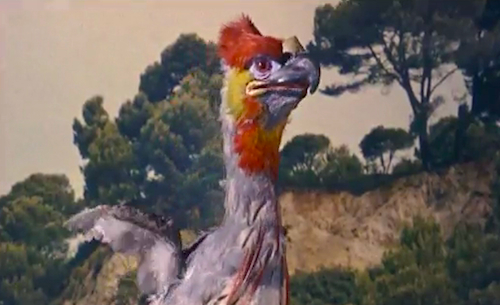 |
?Based somewhat on Jules Verne’s novel The Mysterious Island (a sequel to 20,000 Leagues Under the Sea), the 1961 film — set during the American Civil War — tells the story of a group of Union soldiers having recently escaped from a Confederate prison camp via hot air balloon. Crash landing on the island, the stranded soldiers come into contact with the oversized wildlife — all the result of experiments undergone by Captain Nemo. Including a giant crab and bee, a real standout of this monstrous menagerie is the Phorusrhacos.
From the moment the Phorusrhacos makes its onscreen presence to the oddly playful musical accompaniment, it’s easy to tell that despite the danger the characters are in, the entire scene is meant to be tongue-in-cheek. It’s even been rumored that audiences who saw the movie for the first time believed it to be a giant chicken. While they were indeed wrong in their assumption you can’t blame for making the comparison given the creature’s comical appearance and gawky movements, thus adding to its appeal.
What’s also interesting to note about the Phorusrhacos is that this may also in fact be a homage to a short film O’Brien had made that predates The Lost World entitled The Ghost of Slumber Mountain. This also featured, for a few seconds, a giant flightless bird similar to the one Harryhausen had used in Mysterious Island, not to mention sharing the premise of a remote location of natural wonders.
10) It from It Came From Beneath the Sea
During the 1950s you couldn’t go far in your Thunderbird with your best gal without seeing a movie poster promoting a creature feature of some kind, typically starring a monster whose name was a mere pronoun. Such was the case with It, the giant octopus from the 1955 film It Came From Beneath the Sea. Hydrogen bomb testing near the Mindanao Deep irradiated a giant octopus living in the area, causing It’s natural food supply to be driven away due to in part to its now radioactive nature. Looking to sate its massive appetite, the octopus finds that people make for a nice alternative to fish, whales or what have you. At first, in standard sci-fi fashion, the scientific community is skeptical of the octopus’ existence until it actually starts eating people faster than a fat man at an all-you-can-eat buffet.
The great thing about It is that he (she?) embodies the stories sailors and explorers of yore used to tell about giant squids and octopuses the size of islands attacking passing ships, dragging entire crews to cold watery graves. And with this movie, Harryhausen brought these nautical tales into a more modern setting and showed just how much damage and devastation a sea monster can cause if allowed to wreak havoc on America. Another interesting tidbit about the octopus is that this was one of Harryhausen’s more expensive monsters since the film’s producer only granted him enough money to create and animate six tentacles — not eight. Scientific inaccuracy just to save a quick buck…
9) Mooncalf from First Men in the Moon
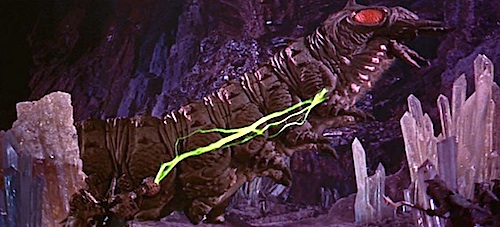 |
?Forget everything you’ve learned about the 1969 moon landing in school because according to the 1964 film First Men in the Moon it’s all indicative of a backwards educational system. Fact: the first moon landing was in 1889 and claimed in the name of Queen Victoria by British explorers. Second fact: the moon is inhabited by a race of insectoids dubbed “Selenites” and the creatures they keep as livestock: mooncalves. That’s right, our most brilliant Earth scientists — in their infinite wisdom — named a giant, vicious space caterpillar after a cow because that’s the first thing that immediately springs to mind when one of these monsters is chasing you through moon caverns.
Still, regardless of mankind’s lack of imagination when giving a newly discovered species a name, the mooncalf is a fantastic monster in that it really draws inspiration from the giant insects of classic sci-fi comics such as Flash Gordon, whether or not this is the case. On top of that, the mooncalf gives off a very kaiju-esque vibe due to the fact it has a resemblance to Mothra in her larval stage. The animation for the monster must have been quite the ordeal too, given that the model in the film appeared to have been dragged along to simulate motion in some shots, all the while making each individual leg move accordingly.
8) Talos from Jason and the Argonauts
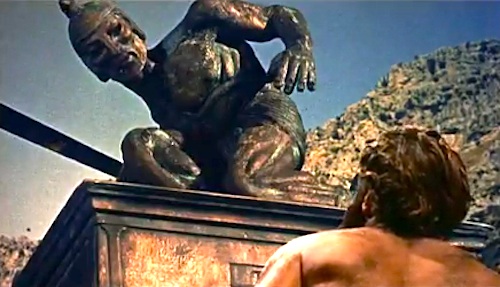
If there’s one mistake every Greek hero or heroine makes on their quest it’s this: just because the gods aren’t exactly using their treasures at the moment isn’t to say that they don’t want it and it’s free for the taking. Hercules and Hylas learned this lesson the hard way in 1963’s Jason and the Argonauts when they incurred the wrath of the hoarder gods and had Talos come to life to crush their miserable lives. Upon his awakening, Talos gets serious and drives his fist through Jason’s pathetic wooden ship, forcing the Argonauts to return to the island where the giant waited. But once they reached the shore, Talos went from bronze badass to an incompetent schmuck that looked like he didn’t know what to do next. Really, all he did was teeter like a drunk for a bit and apathetically swung his sword around. And all it took to bring him down was to pull the stopper from his ankle and let the molten glop just pour out until he died.
Although he may have dropped the proverbial ball, the scene where Talos awakens, slowly turning his head while those blank hollow eyes pierce Hercules’ — and the viewer’s — soul is considered by some fans of Harryhausen’s work to be a truly creepy moment. Joking aside, he’s still an imposing character, no doubt about that, and the sound of his creaking joints and grim facial expression make for an intimidating foe for Jason and his crew.
7) Taro from The 7th Voyage of Sinbad
I was really going to give the cyclops from The 7th Voyage of Sinbad a tip of the hat here, but the real winner of the film is the dragon Taro, even though he got less screen time than his one-eyed, goat-legged adversary. In the 1958 movie, the characters Sinbad and Princess Parisa are cornered by the cyclops in a cave guarded by Taro. In a last ditch effort, Sinbad releases the dragon from his shackles, freeing him and making a beeline straight towards the pair’s pursuer. The best part of this scene is the priceless expression of the cyclops: he goes from chest-thumping brute to “Oh, shit, what did I just get myself into?” in seconds! While he did put up a good fight, Taro was simply too strong and too pissed off to be taken down. I mean, wouldn’t you be if you were chained to a cavern wall for god knows how long, only to be greeted by a fugly cyclops instead of a, say, female dragon? Sadly, Taro’s appearance was short-lived when Sinbad shot a ballista spear through his neck, causing him to keel over and crush his evil master Sokurah before crossing the pearly gates into dragon heaven.
—-
6) Ymir from 20 Million Miles to Earth
An egg containing a potentially hostile alien creature does not a nifty souvenir for scientific research make. But if the characters of 1957’s 20 Million Miles to Earth had heeded these words then we wouldn’t have been introduced to one of Harryhausen’s most famous creations: the Ymir. When U.S. spacecraft XY-21 makes an unintended splashdown near Sicily, their precious cargo — the aforementioned alien egg from Venus — washes ashore, only to end up in the hands of an Italian zoologist named Dr. Leonardo. That night the egg hatches releasing the Ymir and its insatiable appetite for sulfur. But thanks to the U.S. and Italian armies shared policy of shoot first, ask questions later — and the fact Earth’s oxygen-rich atmosphere makes the Ymir grow at an exponential rate — the alien flips out and turns Rome upside down.
The concept of the Ymir is pretty unique since it avoided your archetypal alien predator/conquerer in that it fed on sulfur for sustenance and not people. Also, it was attacking out of fear and confusion as opposed to going to town on humans as prey or following a mandate to subjugate lower lifeforms. So really, who were the monsters here? The Ymir or mankind in their pursuit of knowledge? While the Ymir only appeared in this one film, his design was revisited to a degree in another of Harryhausen’s works…
5) Beast from The Beast from 20,000 Fathoms
The brontosaurus that rampaged through the streets of London in The Lost World may be considered the granddaddy of cinematic giant monsters, but when talking about the advent of the creature feature boom of the 1950s, we have the titular creature of 1953’s The Beast from 20,000 Fathoms to thank for that. A nuclear bomb test in the Arctic Circle inadvertently awakens the Beast from its 100 million year hibernation within the ice. Making up for lost time, the prehistoric monster leaves a path of destruction across the East Coast of the United States, devouring the general populace and causing insane property damage. If that wasn’t bad enough, the military, in response to the Beast, makes the situation worse by blasting a hole in its neck unleashing an ancient disease derivative from the Beast’s blood. So after a few more hours of mayhem and bleeding all over the place, the Beast is finally taken down with a radioactive isotope — killing it instantly.
You wouldn’t think so, but there’s plenty of symbolism behind what appears at first glance to be your run-of-the-mill prehistoric terror. Like the other radioactive monsters that would succeed it, the Beast is mankind’s fears of nuclear warfare and its repercussions given a frightening form. And due to this, the Beast would eventually help to inspire giant movie reptiles in a similar vein such as Gorgo and, the most famous of all, Godzilla.
4) Kali from The Golden Voyage of Sinbad
Each time Harryhausen was called in to provide the special visual effects for the film projects he was hired on for, it was plain to see that he always improved his craft with each new monster becoming more complex and intricate in their movements and design. So while 1973’s The Golden Voyage of Sinbad had its share of memorable mythological beasts, the fight with the enchanted Kali statue simply defies logic and goes beyond the meticulous. You really have to admire the amount of painstaking effort that went into making each of her arms move simultaneously as well as keeping in time with the sword swings from the actors. Not once in the scene is their a noticeable hiccup; the animation is smooth from the beginning to the end. As with all of the beings of myth Harryhausen brought to life, he certainly gave justice to Kali and her ancient reputation as a destroyer goddess.
3) The Kraken from Clash of the Titans
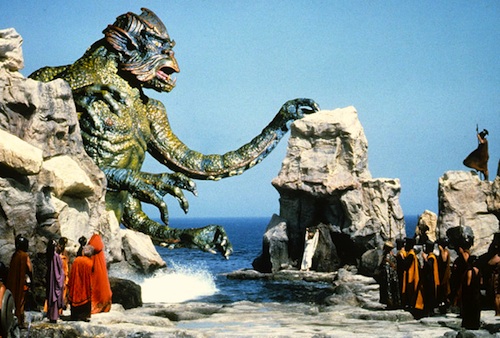 |
?Remember the Kraken from 2010’s Clash of the Titans? The very same one that made some people start saying “Release the Kraken!” to the point where you wanted to just roll yourself under the wheels of an oncoming bus? Well, that Kraken’s got nothing on the original 1981 version — even if it looked nothing like the octopus/squid Norsemen of years past described. Literally the poster child of the original Clash of the Titans from 1981, the Kraken has become the de facto mascot of Harryhausen’s work among his fanbase and is, more often than not, brought up in discussions on the greatest giant monsters of cinema. And it doesn’t hurt that he looks like a cross between the Creature from the Black Lagoon and a gorilla (very cool!).
Recall what I said about the Ymir a few entries back regarding his design. Yep, the Kraken is a dead ringer for its diminutive Venusian cousin, granted there are a few more arms and fins thrown in. For all we know, the Kraken could be the Ymir’s estranged father that he never met… and never will since, you know, the whole thing with Medusa’s head and being turned to stone.
2) The Children of the Hydra from Jason and the Argonauts
The animation that went into the Children of the Hydra is every bit as complex as Kali, if not more so, since Harryhausen had to work with more than one model in the scene and be sure that their movements were timed according to those of the actors. But when compared to the more, let’s say bulkier creature models, the skeleton army looks extremely fragile with extra care most likely being taken to avoid damaging the brittle pieces. What’s also amazing is that Harryhausen was able to give each skeleton a menacing persona thanks to the clever use of body language in their hunched postures and the molding work done on the skulls for that glint of evil on something that is otherwise incapable of giving off expression. All in all, this is one of those scenes that has to be watched over and over again to truly appreciate the magic that only dynamation can deliver.
1) Medusa from Clash of the Titans
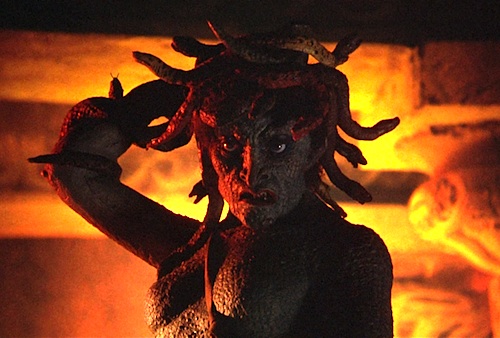 |
?Before Clash of the Titans ever hit theaters we all tended to think of Medusa as nothing more than an ugly, scaly chick with snakes for hair wearing your standard ancient Greek vestment; not exactly horrifying. Harryhausen, on the other hand, saw something more to the tale and certainly wished to evoke the terror ancient Greeks felt when having her story related to them. And if the final product is anything to go by, he succeeded in his endeavor and created a monster that would surely make a brown stain appear in the hindquarters of any ancient Greek’s freshly pressed chiton.
The scene in which Perseus and his warriors enter her darkened chambers is absolute cinematic brilliance being that it flawlessly captures the tension of the ordeal, especially when they all scramble to take positions in the room waiting for her entrance, which in itself is chilling. From the way she comes into the meager lighting dragging her snake-like body in an inhuman manner to the unnerving sound of the rattle at the end of her tail, Medusa hits all the right marks (and most of Perseus’ little squad of warriors) in what a movie monster should be: scary, but in a way that’s disconcerting and not a cheap scare that lasts only for a few seconds. And while a monster biting the big one isn’t anything new in a Harryhausen flick, Medusa’s death and beheading is surprisingly gory, severed head and steaming blood goo and all…
