
The 10 Worst Atari 2600 Arcade Game Ports
 |
?By Teague Bohlen
The ’80s was the decade of the arcade. And the early part of the decade was dominated by the Atari 2600. But even when these two juggernauts were at their heights of popularity, they were not two great tastes that tasted great together. Part of it was that the abilities of the two platforms were just too different. And there were some exceptions. Space Invaders worked fine, probably because the original was so basic. Asteroids looked crappy, and flickered like mad, but if you thought of it as its own game sort of based on the original, it was still fun. Same for Phoenix, Missile Command, Battlezone, Night Driver, and a few others. But coin-ops in general didn’t fare well in their translation to 8-bit. Some worse than others… by which we mean these.
10) Amidar
Okay, it’s tough not to attack the game itself (which is pretty nonsensical, since you’re either a gorilla or a painter, chased by either headhunters and pigs… ooookay, fine), but the port itself is just as goofy. The pace is glacial, even for a relatively slow game like Amidar‘s arcade original, and worse, you can’t really tell what the characters on screen are without referring to the box the game came in. Not an uncommon complaint for the 2600, granted, but still — there’s bad, and there’s worse.
9) Gorf
Let’s get this straight: Gorf in the arcade was awesome. Gorf on the 2600, though? True Gorfian doom. It’s probably by comparison to the original that the 2600 version pales most–always true for 2600 ports, obviously, but there are some serious missing elements between the original and the port, in this case. Most egregious are the missing sound effects, which frankly was one of the main things that made the arcade version so compelling. But also, the absence of the ability to move up and down, rather than just left or right, makes this too much a simple variation on Space Invaders. Sad news for real Gorf-maniacs.
8) Breakout!
Unlike the 1976 arcade original, the port at least boasted actual colored bricks instead of monochrome bricks with a cellophane overlay on the display screen. Yes, seriously. (Video games? You’ve come a long way, baby.) But the arcade version had something that the designers of the Atari version didn’t bother with: geometrics. For gameplay based on angles (the only way to direct the ball in a desired direction was to hit it back close to the edge of your “paddle”), Breakout! definitely broke some rules in coming to the 2600.
7) Defender
Fans loved this game in the arcade, and rightfully so–despite the fact that it was insanely hard to master. But the 2600 version took the basic graphic translation, and changed so many things that it almost becomes a different game. Seriously, if you have to go off-screen in order to fire a smart bomb, it’s not serving the same function as having a button to frantically hit if you find yourself in trouble. More importantly, the port introduced a brand-new (and stupid) element to the game: the fact that your ship actually disappears for a second when you fire your lasers — something that can be, and certainly was, exploited. Not a bad game, per se — but also not Defender.
6) Pooyan
The arcade Pooyan had a silly name, bright and clean graphics showing off fairy-tale characters, and precision archery gameplay. The 2600 version settles for just the silly name. Are those wolves, or the Pitfall alligator heads coming back for revenge? And seriously, my digital calculator watch from junior high had better sound effects. The only thing the 2600 brought to the game was that the name made a little more sense — it totally puts the “poo” in Pooyan.
—-
5) Tutankham
Did you know that the tombs of ancient Egypt were actually a bright puce? And sort of patterned after that shirt Ernie always wore on Sesame Street? Weird people, those Egyptians. This awful port of the arcade original is just terrible all the way around: bad sound, bad visuals, bad gameplay. The hallways are oddly sized and tough to maneuver. Your character doesn’t have any animation at all, and like the original, can only shoot sideways (something I never understood in the original game, for that matter). Which wouldn’t be so bad, if not for the constant flickering, and the getting stuck on a hallway corner, which allows the poorly-rendered enemies to catch you even more easily. This honestly should have been buried out in the desert with all those unused E.T. cartridges–after all those years in the ground, even junk is worth something.
4) Congo Bongo
I knew Congo Bongo, Atari 2600. Congo Bongo was a friend of mine. And you, sir, cannot run Congo Bongo. To be fair, it’s not completely your fault. You weren’t designed with isometric perspectives in mind. The 2600 port of Zaxxon had similar problems, but that game at least retained some of the gameplay that sold fans on the original. Congo Bongo, not so much — maybe because the perspective was more integral to the game itself? Tell me again why anyone ever thought making a bad version of a good game equalled a good idea?
3) Donkey Kong
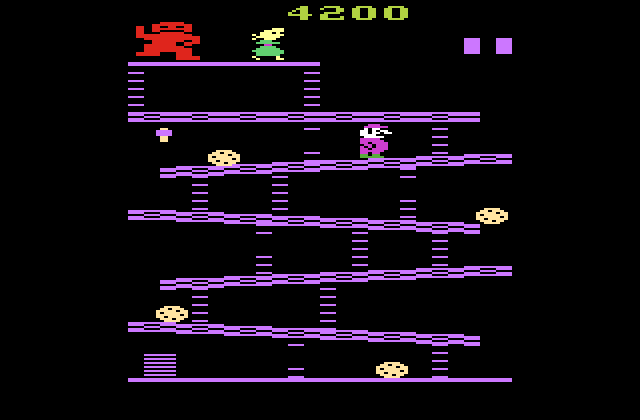
Continuing the ruined-monkey theme…how does the port of this legendary game bug? Let us count the ways. Or at least count the levels–it won’t take long. One, two. There, we’re done. That’s it. Two levels, and you’re out. But even two good levels of Donkey Kong is better than nothing, right? Not when barrels look more like chocolate chip cookies, the fireballs look like giant yellow sperm, and Kong himself looks like a baked and hatless Pillsbury Dough Boy. Remember up above when I said that there’s bad, and there’s worse? Well, there’s one more level to that; there’s bad, there’s worse, and there’s Donkey Kong.
2) Burgertime
I was never a fan of this game in the arcades — it always seemed like a Donkey Kong rip-off with a new, thin, fast-food veneer. But the home version was far worse. Slow as Heinz ketchup. And ugly — you know the blocky graphics have reached a new level of bad when you can’t tell the difference between an egg and a pickle. And most importantly, almost unplayable. Inherent in the game strategy is that Peter Pepper can shake some pepper at enemies to pause them and escape their clutches — but in the 2600 version, it actually pauses (and sometimes crashes) the game. Burgertime is no Happy Meal.
1) Pac-Man
Number one not so much because of sheer lack of quality (though it’s got that, too), but rather because of its infamy. This cartridge was one of the most anticipated in the life of the 2600 system, mainly because Pac-Man itself (the game and the character) were pop-culture icons already. There were Pac-Man toys, a Pac-Man Saturday morning cartoon, Pac-Man sheets, even a Pac-Man song that sucked, but still hit big because it was about Pac-Man. And then came the Atari 2600 version, rushed through production and into stores for Christmas. And it was…awful.

About The Author

Robert Bricken is one of the original co-founders of the site formerly known as Topless Robot, and its first editor-in-chief, serving from 2008-12. He brought the site to prominence with “nerd news, humor and self-loathing” as its motto, raising it from total internet obscurity to a readership in the millions, with help from his savage “FAQ” movie reviews and Fan Fiction Fridays. Under his tenure Topless Robot was covered by Gawker, Wired, Defamer, New York magazine, ABC News, and others, and his articles have been praised by Roger Ebert, Avengers actor Clark Gregg, comedian and The Daily Show correspondent John Hodgman, the stars of Mystery Science Theater 3000 and Rifftrax, and others. He is currently the managing editor of io9.com. Despite decades as both an amateur and professional nerd, he continues to be completely unprepared for either the zombie apocalypse or the robot uprising.