
BACKLOG.TXT: Revisiting Ultima Underworld, The Grandfather of Immersive Sims
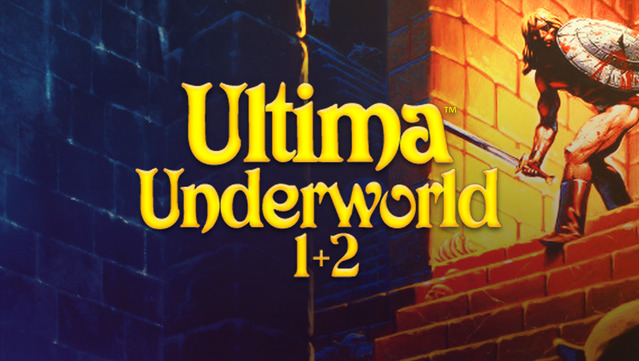
Today on BACKLOG.TXT: Revisiting the grandfathers of the immersive sim genre, Part 1 of 2.
Welcome to a very special BACKLOG.TXT, where we will be taking a look back at not one, but two treasured relics from the past: the Ultima Underworld series. Do these ancient titles still hold up today? Are they still playable, or too arcane and aggravating for modern gamers? After spending over 60 hours with gameplay and research, I believe I have finally arrived at the answers. Part 1 will be a deep dive into Ultima Underworld, the game that inspired countless others. Part 2 will examine Ultima Underworld II, the direct sequel, and how it further improved the formula.
Ultima Underworld’s Far-Reaching Influence
Ultima Underworld and its sequel are often cited as an inspiration for many of the nonlinear, exploratory titles gamers have come to know and love. The Elder Scrolls, Deus Ex, Bioshock, and Dishonored are just a few of the blockbuster series that owe a debt of gratitude to this pair of ancient games.
 Underworld Ascendant drops this week – but will it live up to the name?
The long-dormant (but never totally forgotten) Ultima Underworld series will finally be returning to PC and console screens everywhere. The upcoming release of Underworld Ascendant will take place on November 15th, 2018.
Underworld Ascendant aims to recapture that Ultima Underworld magic from a quarter century ago, and will finally see the light of day after four and a half years of development. The sequel was made possible in no small part due to successful crowdfunding, an excited core fanbase, and the involvement of some of the original minds behind the immersive sim genre. This includes industry veterans from Looking Glass Studios. Paul Neurath, Warren Spector, and Austin Grossman are just some of the names gracing the long-awaited sequel.
Since Underworld Ascendant was announced, I’ve been watching with growing excitement. Having never played much of either of the old games in the series, I figured there was no better time to dive deep into the ancient underworlds myself and see what the fuss was all about.
The Ultima Series: A Quick And Dirty History Lesson
Ultima was a groundbreaking series of PC role playing games that enjoyed a solid two decade run, with nearly twenty releases between 1979 and 1999. The brain behind this vast and iconic world, Richard Garriot (aka Lord British), began the series with a simple hack-and-slasher by the name of Akalabeth: World of Doom.
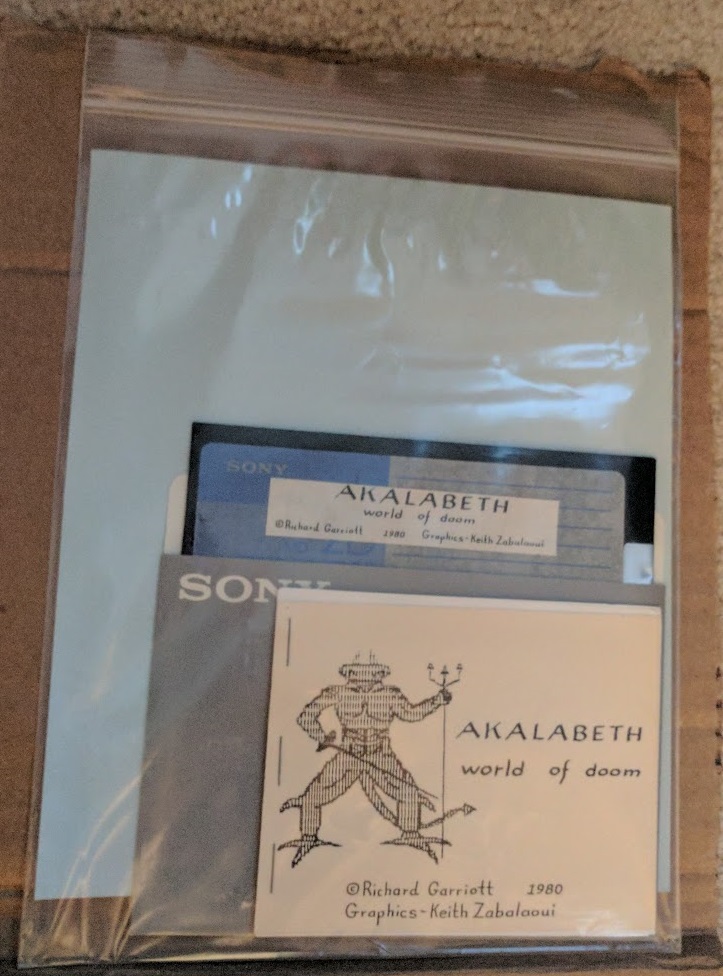
A young Garriot sold copies of his game in Ziploc bags from the shelves of a Computerland retail store – his place of employment. Akalabeth, which series fans now refer to as Ultima Zero, was picked up by publisher California Pacific and went on to sell 30,000 copies. From there, Garriot successfully continued the franchise and went on to co-found his own game company – Origin Systems.
Origin became a studio name synonymous with deep and expansive games, and was purchased by Electronic Arts in September of 1992 – just months after Ultima Underworld’s release. Origin Systems went on to create the first graphical MMORPG, Ultima Online, in 1997 – a game which still has live servers to this day. Following the dismal flop of Ultima IX, Origin was sadly dismantled by Electronic Arts in 2004. Origin lives on in name only, as EA’s sub-par digital distribution system for PC game offerings. It’s a pretty sad legacy for one of PC gaming’s most influential development titans.
As for the world of Sosaria, and the Ultima series itself, both lay dormant and untouched for years. Game archaeologists over at GOG resuscitated Ultima Underworld and its sequel in 2011, adding them to the site’s growing library of forgotten DOS titles. The GOG versions run quite well on modern machines – even though each game has a couple issues. We’ll get to that in a moment.
Disclaimer for Old Guard PC Gamers:
Before I get ahead of myself, yes, I do realize that Ultima Underworld I and II are very well-loved games. I can hear the old-guard PC gamers in the distance already, sharpening their axes so they can chop me to bits and throw the chunks in with the rotworm stew at the first sign of a critical comment.

Hey. I’m here to give these old favorites a fair shake – not rip them apart.
Look. I’m on your side, guys. Old games are important. It’s really cool to see where the influences for our modern titles came from. Not having much experience with these titles since I first saw them as a kid, I’m in a unique position. I can still appreciate Ultima Underworld, and its successor, while maintaining a healthy level of objectivity since my views are less colored by the warm fuzzy lens of nostalgia.
So. Let’s get comfy, crack open a tasty beverage, and take a look back to the past at the game that started it all.
Revisiting Ultima Underworld – The Stygian Abyss

How can you contain your excitement with a title screen like this?
The player takes on the role of Ultima series protagonist, the Avatar, who witnesses the kidnapping of Baron Almric’s daughter. Unfortunately, since the Avatar is caught in the wrong place at the wrong time, the Baron tosses them into the Stygian Abyss, a former colony on a remote volcanic island now turned into an inescapable prison. Your task? Traverse the deadly Abyss, rescue the girl, and prove your innocence.
This all sounds simple enough in theory, but Ultima Underworld’s plot takes a few twists and turns. The Avatar stumbles on evil wizards and demon-summoning plots all while uncovering the fate of the failed colony. This is done via first-person exploration and combat in the game’s revolutionary 3D engine.
Texture-Mapped Game Worlds in 1992?!
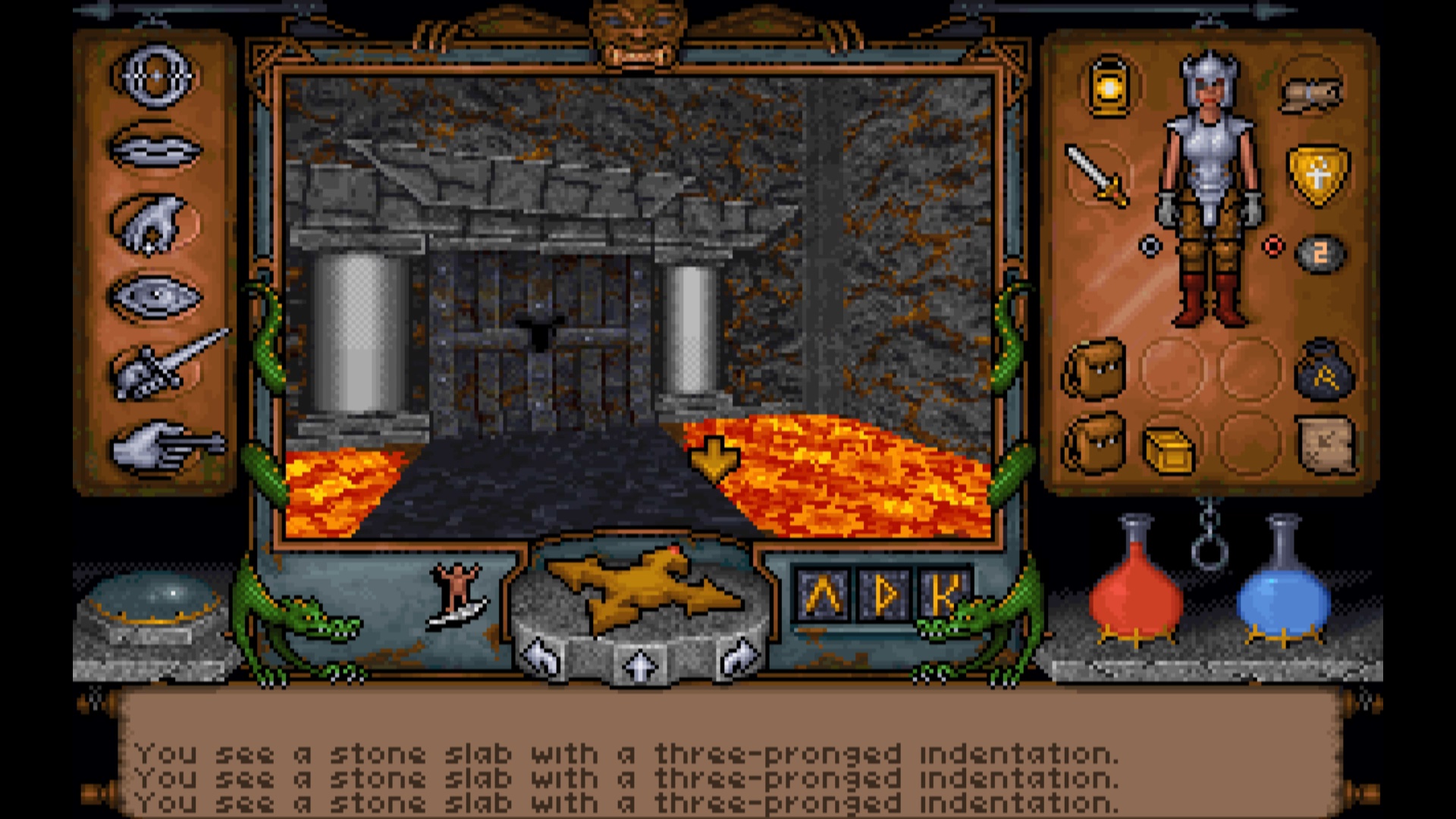
Those walls. Those curves!
I admit, Ultima Underworld isn’t much to look at nowadays. Your viewing window to the world is tiny. The interface is huge and cumbersome. The characters and items are all surrounded with giant ugly black pixels. Textures warp and waver when looking up or down.
Still, for the time, there was nothing like it. Id Software’s raycast engine games, Wolfenstein 3D and Doom, were still a few months away from release. A fully realized 3D world with textured walls, ceilings, and floors was mindblowing by itself in 1992. But sloped floors? Bridges? Smooth lighting? A ton of this stuff gave later games a run for the money, at least on a technical level.
Sounds Like a Problem
As for the game’s sound… Let’s just say that it’s problematic.
Ultima Underworld’s sounds were totally FUBAR when I first started playing. My footsteps were piano noises. Swimming sounded like a xylophone, and harps played when swiping at the various bats and bad guys with my blade. The music was also just BLARING, and there’s no in-game volume controls other than “on” or “off”. I couldn’t play it like this. So… off to the internet we go!
I stumbled across a post describing some configuration file changes. That got me some decent sort of 8-bit style music. The effects were all kind of basic and farty, though. I also found out that it was possible to get the far superior Roland MT-32 soundtrack by downloading some software emulators. The process is kind of complex, and after messing around with it for a while I ended up stuck with the basic Sound Blaster effects and music anyhow.
So… Does the Gameplay Hold Up?
Or is it another case of overblown nostalgia? Well, let’s break it down. First off, the game starts you off with a voiced introduction – impressive, for 1992!
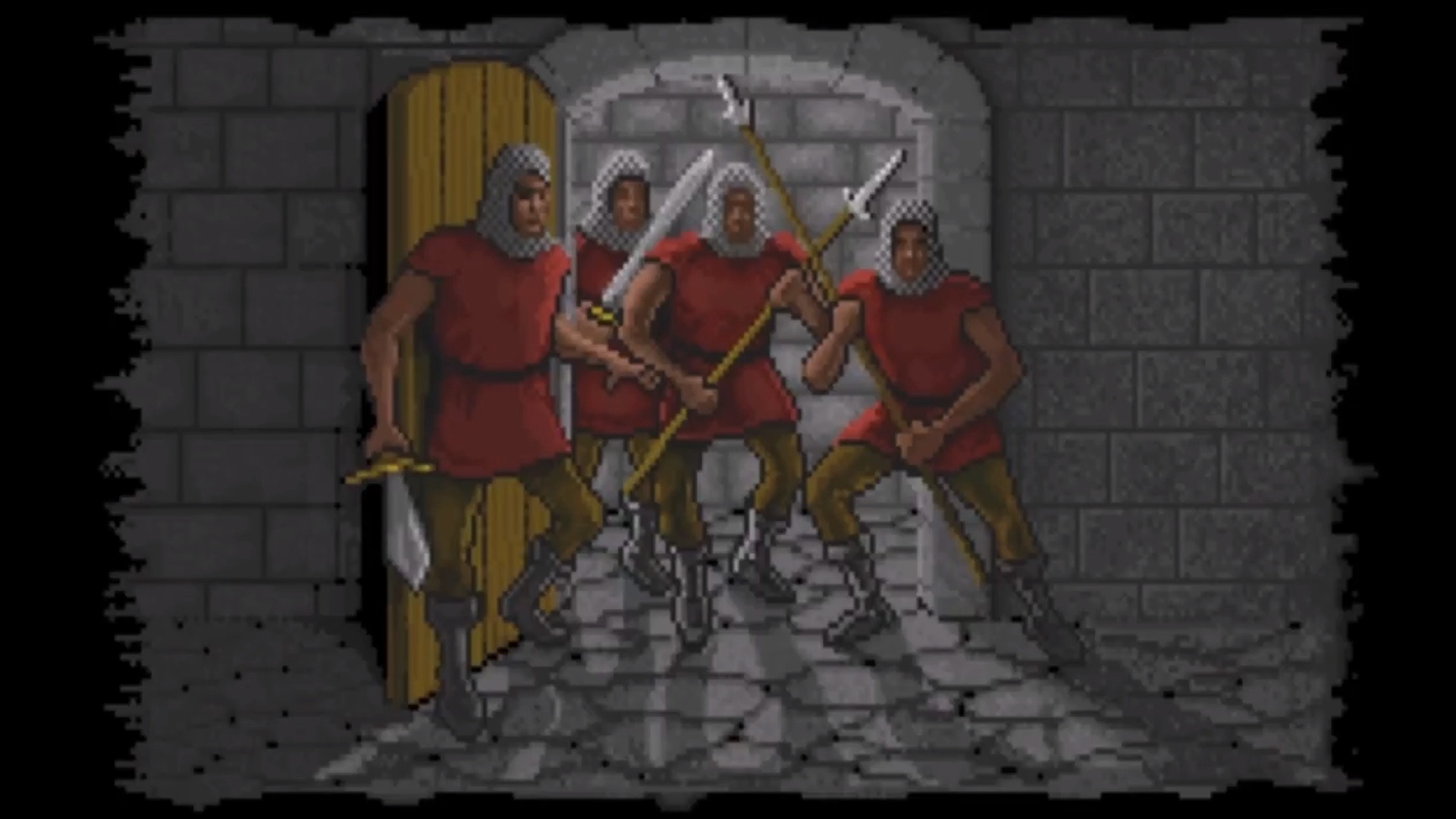
The intro prominently features the Castle Dance Squad.
Then it throws you right to the title screen where you design your Avatar. There’s a lot of choices here, and each of them are explained in the game’s manual. It works best to have that printed out or keep it handy on another screen. While you’re at it, keep the quick reference card and spell list near. (The GOG version conveniently includes all these files, plus a hint book for each game.) Ultima Underworld also really wants players to take notes, and it’s not shy about chucking a lot of information your way.
Creating Your Avatar – A Flawed System
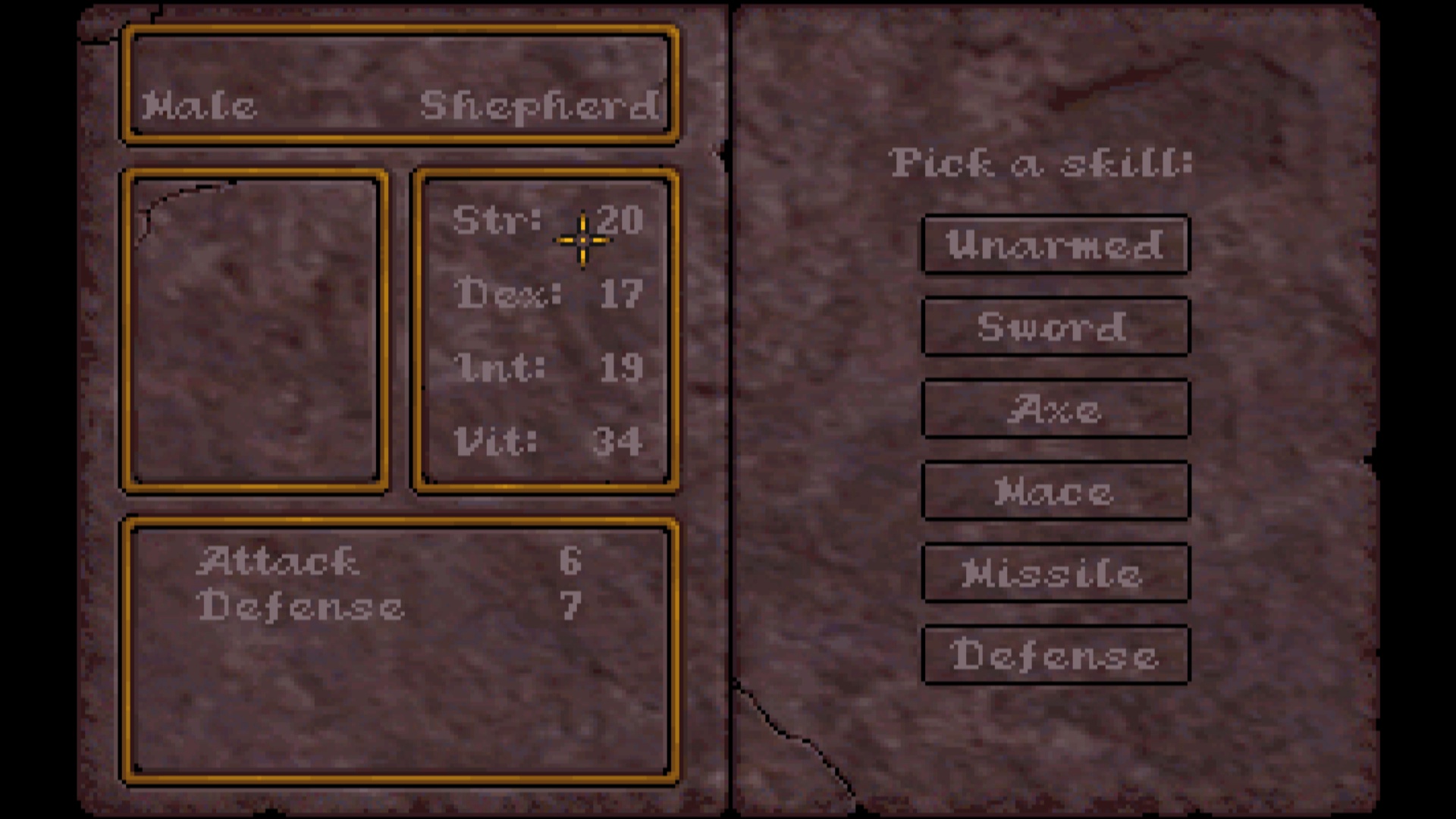
There’s a lot of choices here – too bad they’re not all meaningful.
Even though the game has a pretty big list of stats and skills, there’s only one stat that really matters – Strength. You can’t raise any of your four basic stats, so make sure you pick a class like Druid or Paladin to get a good Strength roll. Otherwise, be prepared to pass up armor or backtrack between numerous stashes of items. The Avatar has a pretty tight weight limit and you’ll be required to carry a bunch of stuff around for a lot of the game. Strength all the way, baby!
Don’t know what skills to take? Well, don’t take Lockpick. Any door that can be picked can also just be smashed with your fist until it opens. Search and Traps are also useless – secret doors are pretty obvious, and there don’t seem to be any traps you can disarm in the entire game. The social skills aren’t needed at all since there’s not much to trade for. Only about 30 gold pieces are needed to finish the main quest, and treasure is everywhere. Lore is nice, but you can use a spell or pay certain characters to identify items. I’d recommend starting with Sword, Casting and Mana. That way you’ll be able to use the best weapons, hit enemies more often, and screw up spells less often.
And before I hear an earful in the comments: Yes, player choice is important. It’s great to be able to suit as many playstyles as possible. However, those choices have to be meaningful in the context of the game. The fact that there’s a ton of skills doesn’t add anything to the game if those skills don’t have a meaningful use – it just cripples players that don’t take the most effective ones.
Take It Easy
You can choose between two difficulty levels. Make it easy on yourself. In my opinion, Easy mode gave the game a better pace. The hit detection in combat is spotty. Walls, or doors, or floors can sometimes get in the way. Hits and misses are determined by behind-the-scenes dice rolls. It’s hard to tell if you’ve aimed yourself correctly at enemies. There’s no feedback or log text that indicates if an attack has missed, even if you’re on target.
Yeah – I can already hear the enraged cries of old-guard Ultima Underworld fans. “Are you LISTENING TO YOURSELF?! The combat is REVOLUTIONARY. You can slash, thrust, and chop with every weapon. Or loose arrows from a mighty crossbow. And you turned down the difficulty?! Ugh, what a friggin’ CASUAL.”

“KILL THE CASUAL!”
I’m up for a challenge, but fun factor trumps everything. Most of the weapons have one attack type that works better than the others, so you’re just going to end up using that one anyhow. The missile weapons are a joke because of the physics, low damage output, and spotty aiming – it’s just not worth it. In both of these games, exploring, plot exposition and puzzle solving are far more fun than clicking the mouse button over and over on a single bad guy. Normal difficulty just means you’ll be clicking your way through a lot more combat, and dying a lot more often. Ultima Underworld is also a pretty hard game, so you’ll need every advantage you can get. I started over my Normal difficulty run and switched to Easy right around the point where I got down to level 2. Trust me: Pick Easy.
Navigating The Stygian Abyss
Once you’re all done making your Avatar, you’re unceremoniously dumped inside the entrance to the Stygian Abyss. You’ll want to take a minute to get used to the controls.
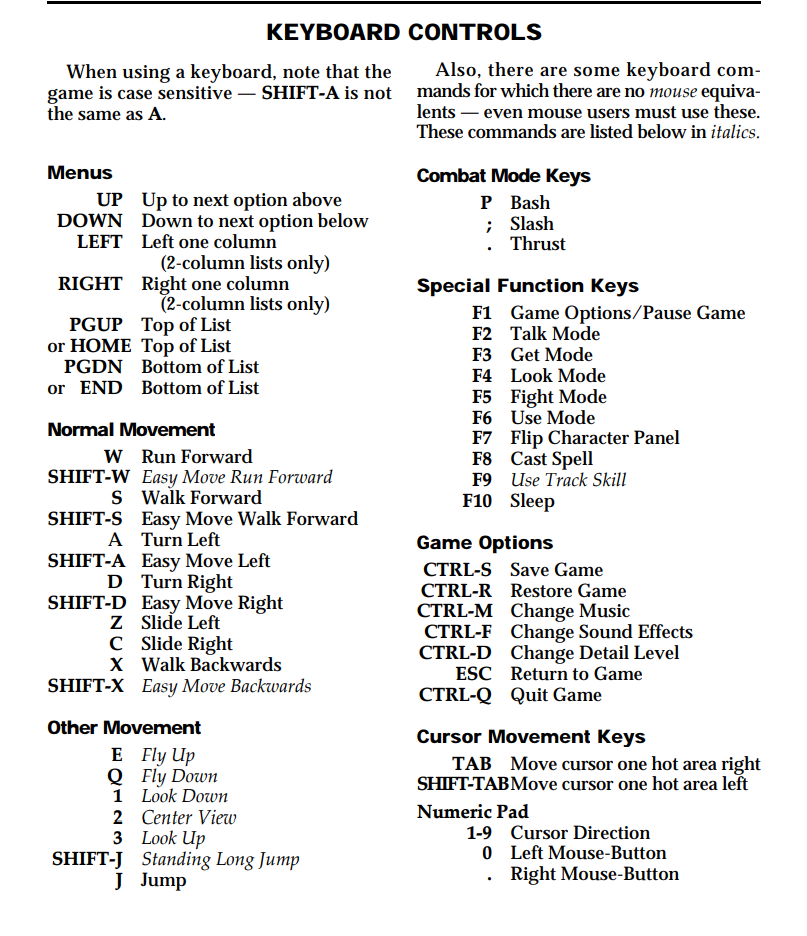
Yeah. There’s a lot.
While you can play with only a mouse, I wouldn’t recommend it. A combination of the WSAD keys to run and turn and the mouse cursor to interact and fight is much more efficient. But then, there’s the jumping. Ohhh. The jumping.
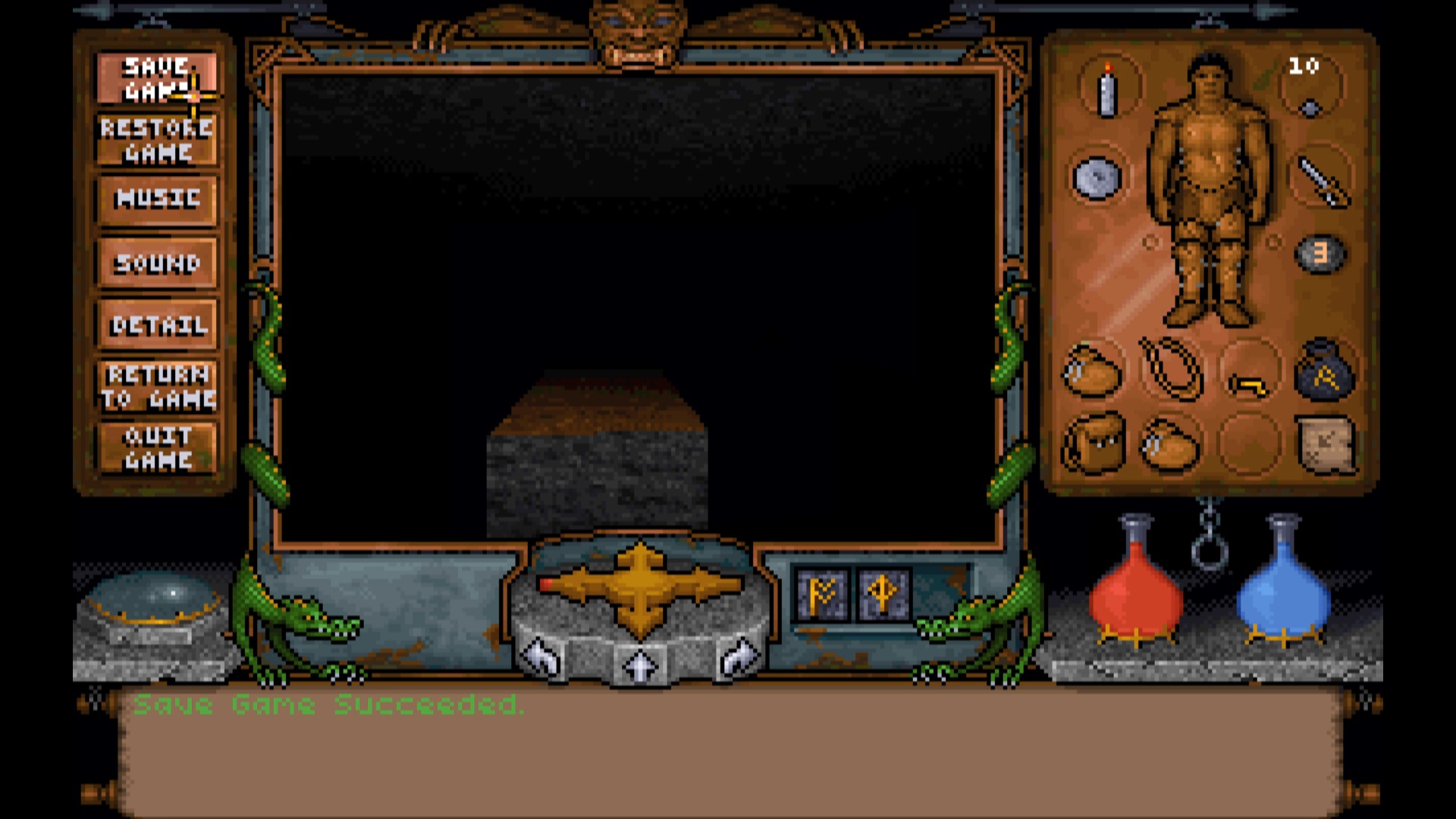
Get ready for lots of janky first person platforming.
Here’s the thing. At this time, developers were just figuring out ways to solve the problem of first person movement. So, a little jankiness is understandable. Still, the jumping in Underworld is just… bad. No way around it. The physics cause the Avatar to bounce around when hitting a surface, so even simple jumps can require some trial and error. What’s worse, there’s a ton of puzzles here that require pixel-perfect jumps to tiny platforms. You can’t see your feet, and you can only look down at about a 45 degree angle. There’s a lot of guesswork involved. Be prepared to save your game before and after every single jump. Later in the game, spells like Fly or Levitate help make this easier, but there’s also certain areas where magic doesn’t work at all, so it’s… back to jumping for you!
The levels in Ultima Underworld are large and mazelike. There’s a lot of different environments, but it’s still easy to get turned around. Good thing the game places a detailed automap in the very first room! Even better, the map allows you to make your own notes. You can use the blank pages to keep track of quests, mantras, spells and other important clues. You’ll need it. Remember when I said the game throws a lot of information at players? Well, at least it provides a decent place to keep it all.
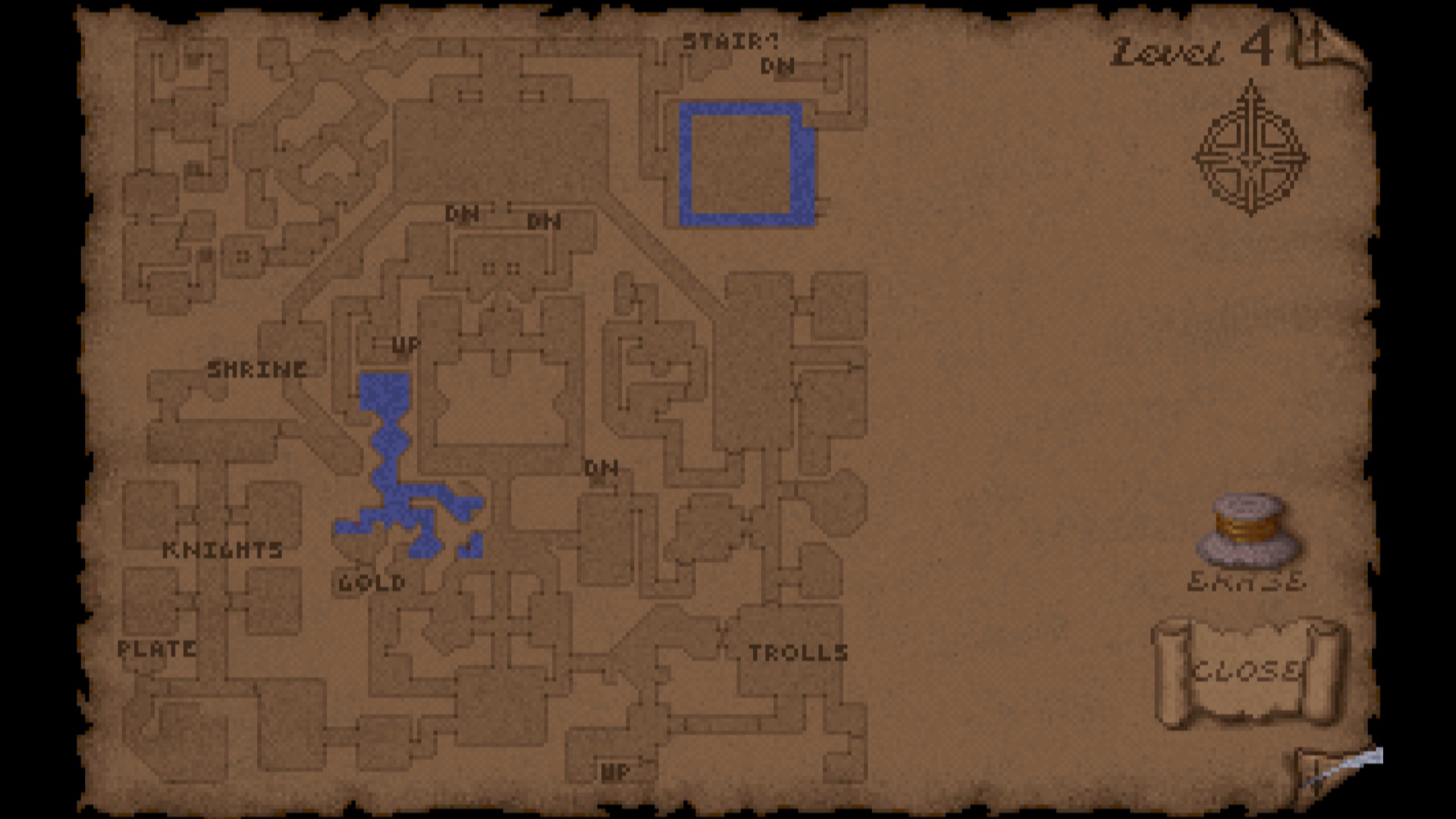
Your map is your best friend in Ultima Underworld.
Believe In Magic
Speaking of magic, there’s a huge list of spells. Sometimes they can be found on scrolls, or by talking to magic users. Spells are all cast by putting combinations of two or three runes together in the Runebag. Each rune is supposed to represent a different element or action, and the system is designed to encourage experimentation.
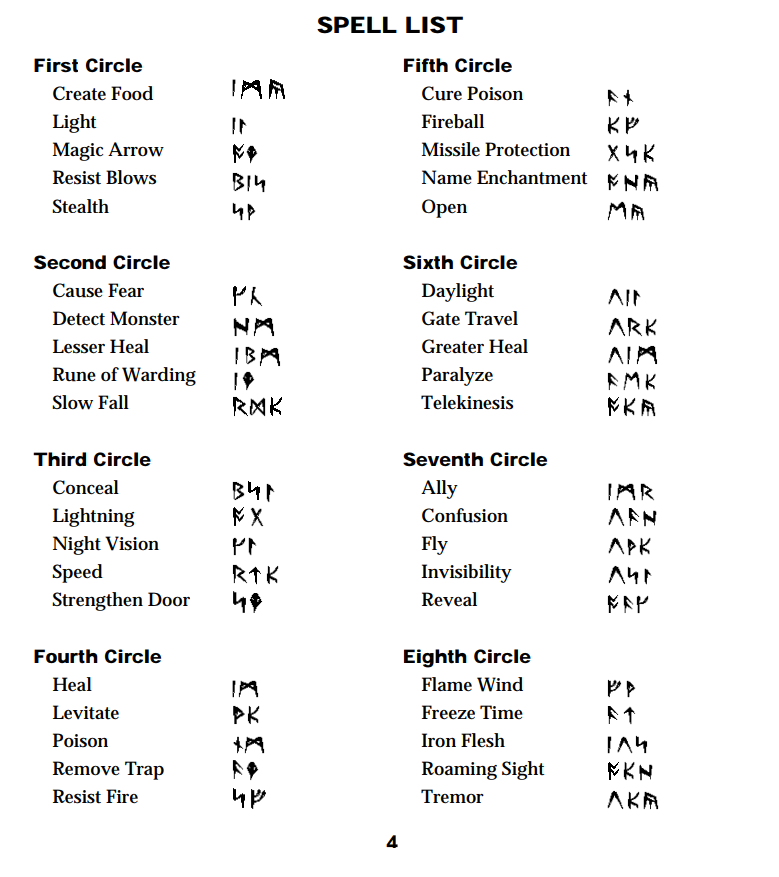
There’s actually even more spells than this that are not documented.
It’s a neat idea, even if it’s a little inconvenient. There’s no way to cast a favorite spell quickly or easily switch between them since you have to fart around with the rune bag. Doing this during combat is pretty impractical. Instead, you’ll want to use spells to light your way, create food, open doors, levitate, and enhance your defense. Magic is important – maybe even necessary – for getting through the lower levels of the Stygian Abyss.
There’s even a hidden “game over” spell called Armageddon that removes every item and character from the world. This makes the game unwinnable, though. Either way, you’ll want to max out that Casting skill as soon as you can.
Now That’s What I Call Progress
In order to increase your skills, the Avatar earns experience levels. However, you still have to find shrines to train up your newly acquired skills. Once you finally stumble across a shrine, you’ll have to chant the correct mantra to train up the skill you want. Ultima Underworld makes you actually type in these mantras. The manual lists a few of the basic ones, but the rest have to be found as clues in the game world or from character conversations.
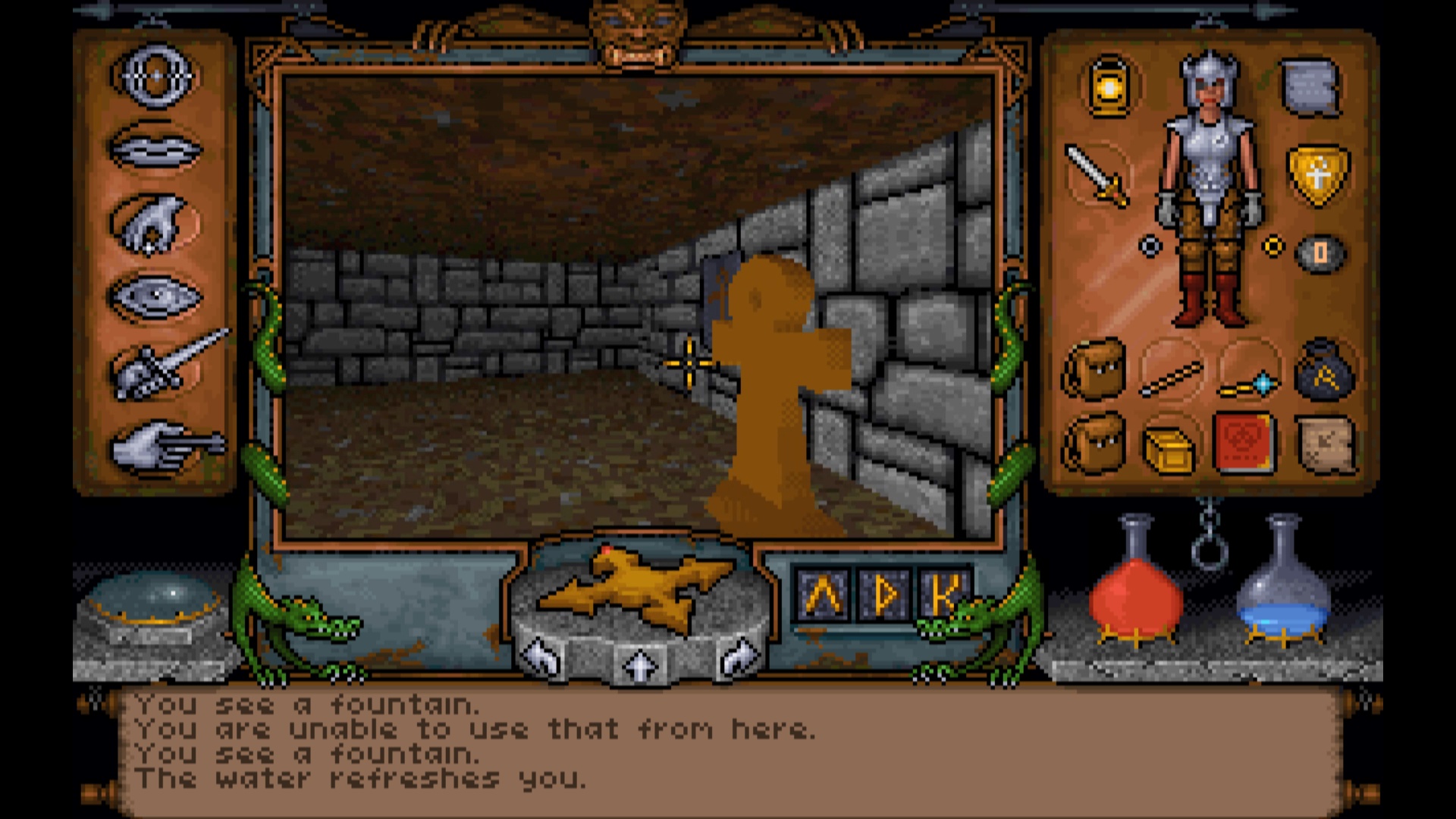
A shrine-ing example.
So, to recap: progression requires gaining experience levels, heading to a shrine, then knowing the correct mantra to chant. This seems like a neat idea, adding more “simulation” elements into the game. In practice, it’s needlessly complicated and adds a lot more backtracking.
Once you get used to the controls, Ultima Underworld excels at exploration. The Stygian Abyss is pretty detailed. The Avatar needs food, sleep, and light. Equipment degrades with use. There’s a ton of characters to speak with, including a talking door (ins footage), and not all of them need to be put to the point of a blade. Even the goblins can be friendly. Discovering new communities and helping them with their problems, or finding creative and nonviolent ways to further your quest, is pretty fun and fulfilling. Or, if you prefer, you can sometimes take the violent way out and just hack and slash your way to victory.
Ultima Underworld: Arcane, but Still Immersive
Overall, I’d say that Ultima Underworld is still a pretty entertaining immersive sim, even though it’s clear that a lot of the ideas behind it were unrefined. It doesn’t hold up as well as most of its modern successors, and that’s largely due to some confusing and unintuitive design choices. Still, if you’re willing to stick out the arcane control scheme, there’s a pretty compelling game hiding underneath.
Does Ultima Underworld II improve on the first? Come back next week for a comparison in Part 2! Or, check out the video breakdown for both games on 2 Headed Hero!
- Chandon, also known as Bawss Sawss, is a sauce aficionado, gamer, writer, musician, and one head of the 2 Headed Hero gaming channel on YouTube. He can be reached on Twitter, Instagram, or Facebook.
- 2 Headed Hero’s quieter half, Rollinkunz, is the channel’s illustrator, gamer, writer, boardgame designer, He can also be reached on Twitter, Instagram, or Facebook.
Backbone Prologue: A Trash Panda Detective Tale | BACKLOG.TXT
Today’s BACKLOG.TXT deals with a teaser: the highly original adventure/stealth hybrid Backbone: Prologue. On 2 Headed Hero, we tend to keep an eye out for indies that might otherwise slip by. Fortunately we’ve dumpster-dived through enough of the garbage to sniff out a quality clue. Prefer to watch? Click the video above or visit us on 2 Headed Hero’s YouTube channel!
Be Free, Eat Trash
Backbone was successfully Kickstarted by Canadian developer Eggnut in 2017, and the full game is aiming for a multi platform release in 2020. While Backbone: Prologue is only about the first forty-five minutes of the full upcoming game, this noir trash-panda detective tale is shaping up to be a clever delight.
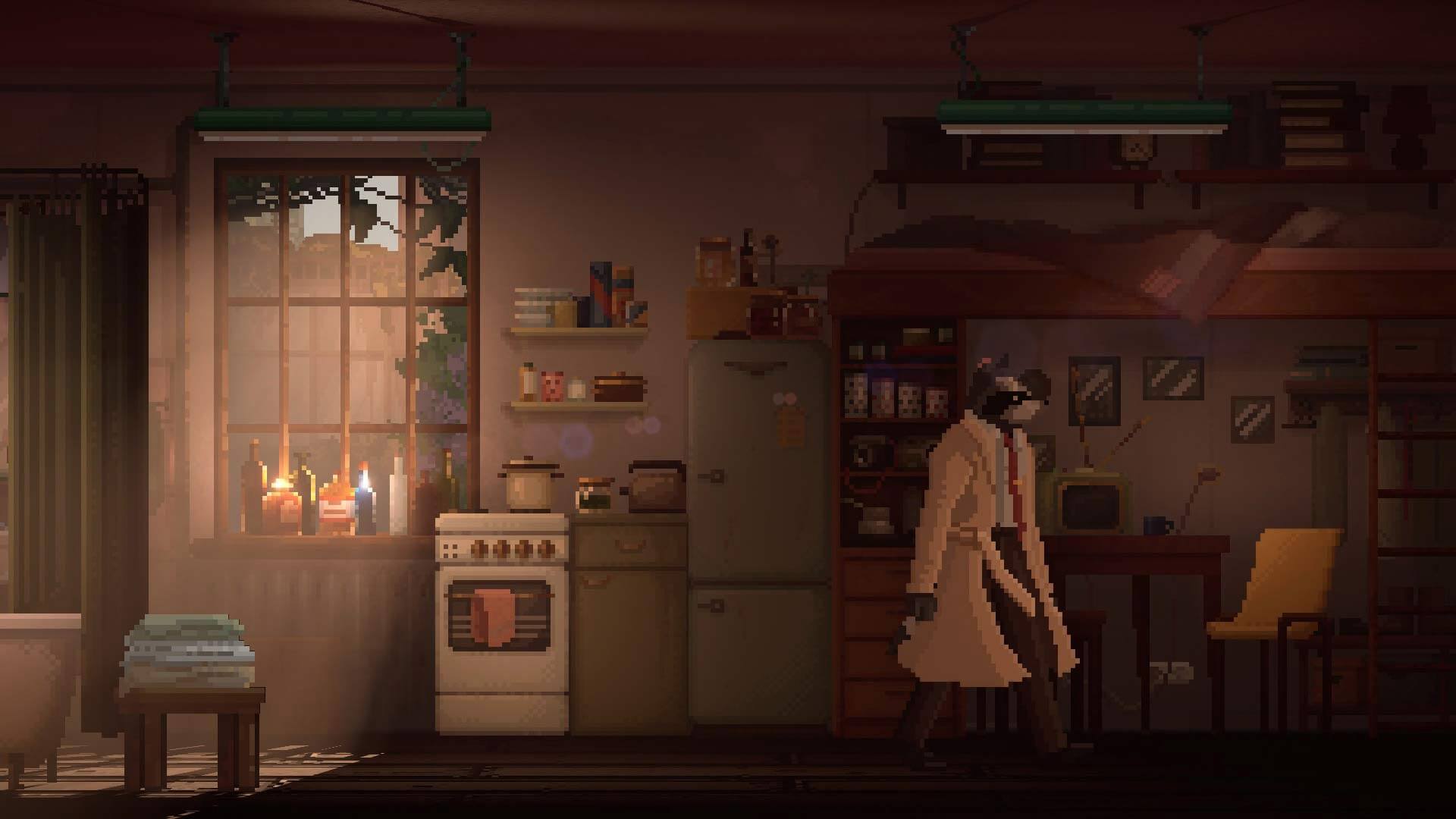
Players step into the shoes of anthropomorphic private investigator Howard Lotor and stumble across a dark and sinister mystery in a re-imagined Vancouver. The world is now populated by a flurry of fursonas, without a single normal human in sight, but the gritty tone Backbone Prologue sets is definitely not kiddie fare.
Unreal Techniques
Backbone: Prologue uses a modern pixel art style – no black outlines here – and the visuals are smartly enhanced by Unreal Engine lighting effects. The sprites in each scene are set up as flat set pieces and objects in a 3D space with a fixed-distance camera. This allows for the sort of subtle lighting and dynamic shadows that can really help players buy into these environments while still maintaining the pixel-platformer format.
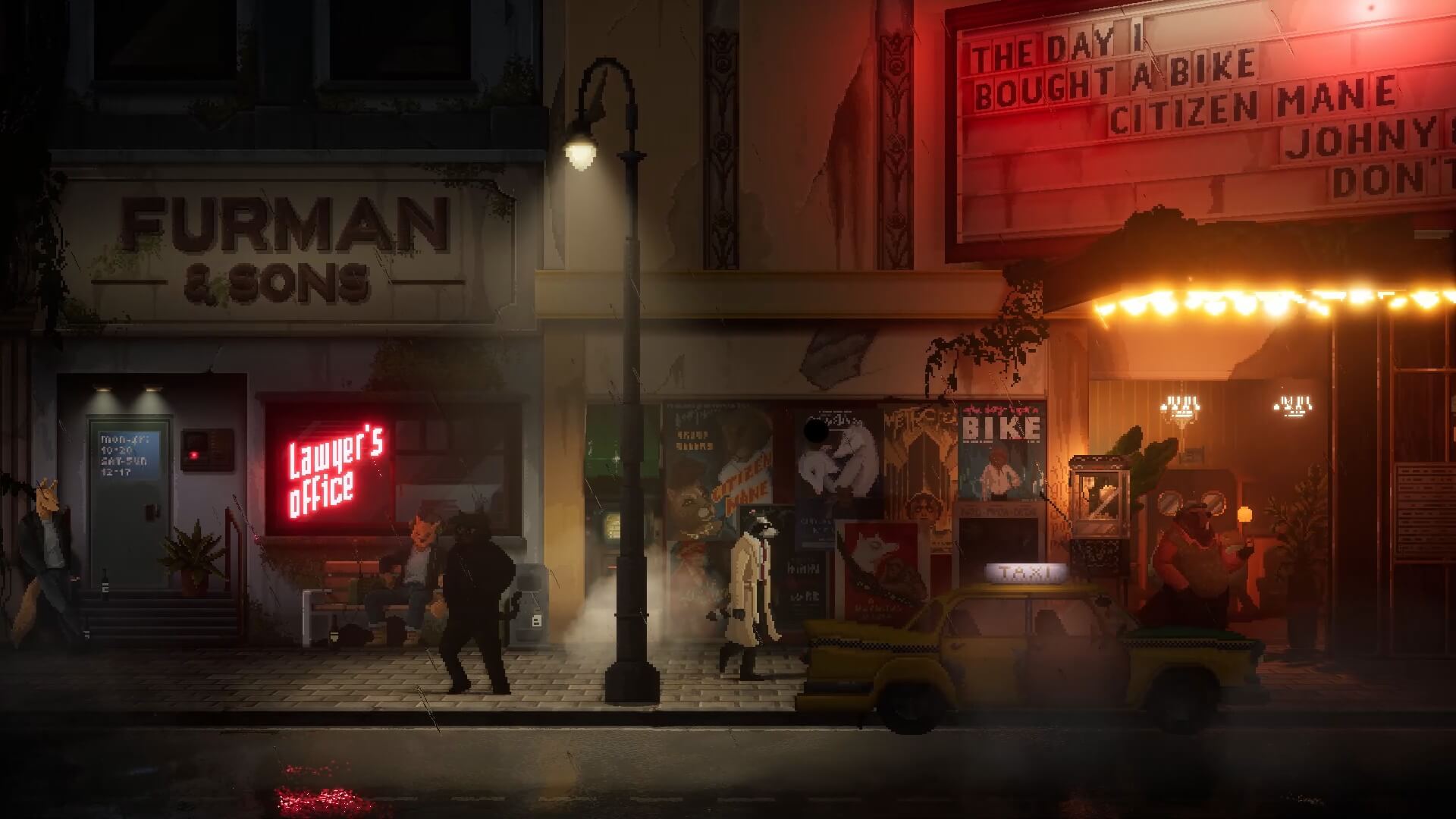
These techniques, along with an impressive number of animated background actors, further bring the setting to life. The result is a gritty, bustling pixel-noir – an interesting juxtaposition between the childish and the very-much-not-so.
Smooth Jazz
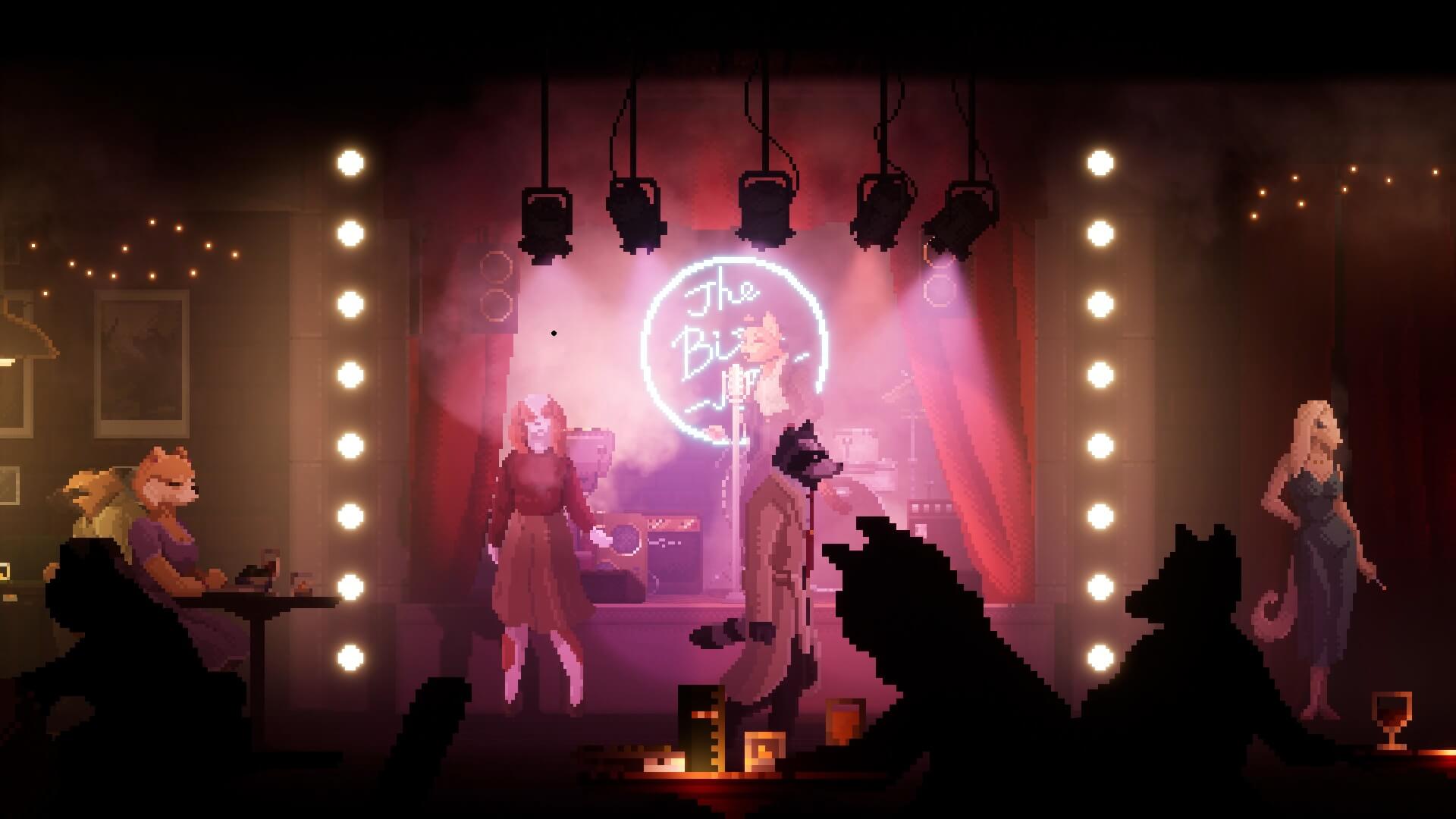
The jazz soundtrack is phenomenal, even containing lyrics.
Sounds in Backbone: Prologue ooze with atmosphere. The moody jazz soundtrack compliments the bustle of the city and the pitter-patter of gently falling rain. The wet slaps of your garbage-loving gumshoe’s feet hitting the pavement are balanced just right in the audio mix. Once inside the interior of the nightclub, Backbone: Prologue’s musical numbers shine through, even including a gorgeous jazz tune complete with lyrics.

While there’s no voiceovers – yet – the team met their Kickstarter stretch goal to include full voicework. Voiceovers can often make or break a game’s atmosphere, and while the tiny taste in Backbone: Prologue stands on its own, I still eagerly look forward to hearing how actors approach the dialog here.
Play It Cool
As it stands, Backbone: Prologue currently features three flavors of gameplay: dialog, puzzles, and stealth sections.
Dialogue trees provide options for handling your clients and the city’s denizens, though it’s unclear how much your choices actually matter. Presumably, you can’t back yourself into an unwinnable situation no matter how hard-boiled a private dick you choose to be. Since brute force dialog puzzles are often an annoyance in adventure games that bring pacing to a halt, it’s nice to see Backbone: Prologue’s gentler approach.

That’s a big big bunny.
Backbone: Prologue’s stealth sections were puzzle-like and precise, but not entirely devoid of necessary wiggle-room. Distraction items in the environment help Howard get in where he’s not wanted, and failing these merely boots you back to the start of the sequence. Overall, they broke up our session nicely.
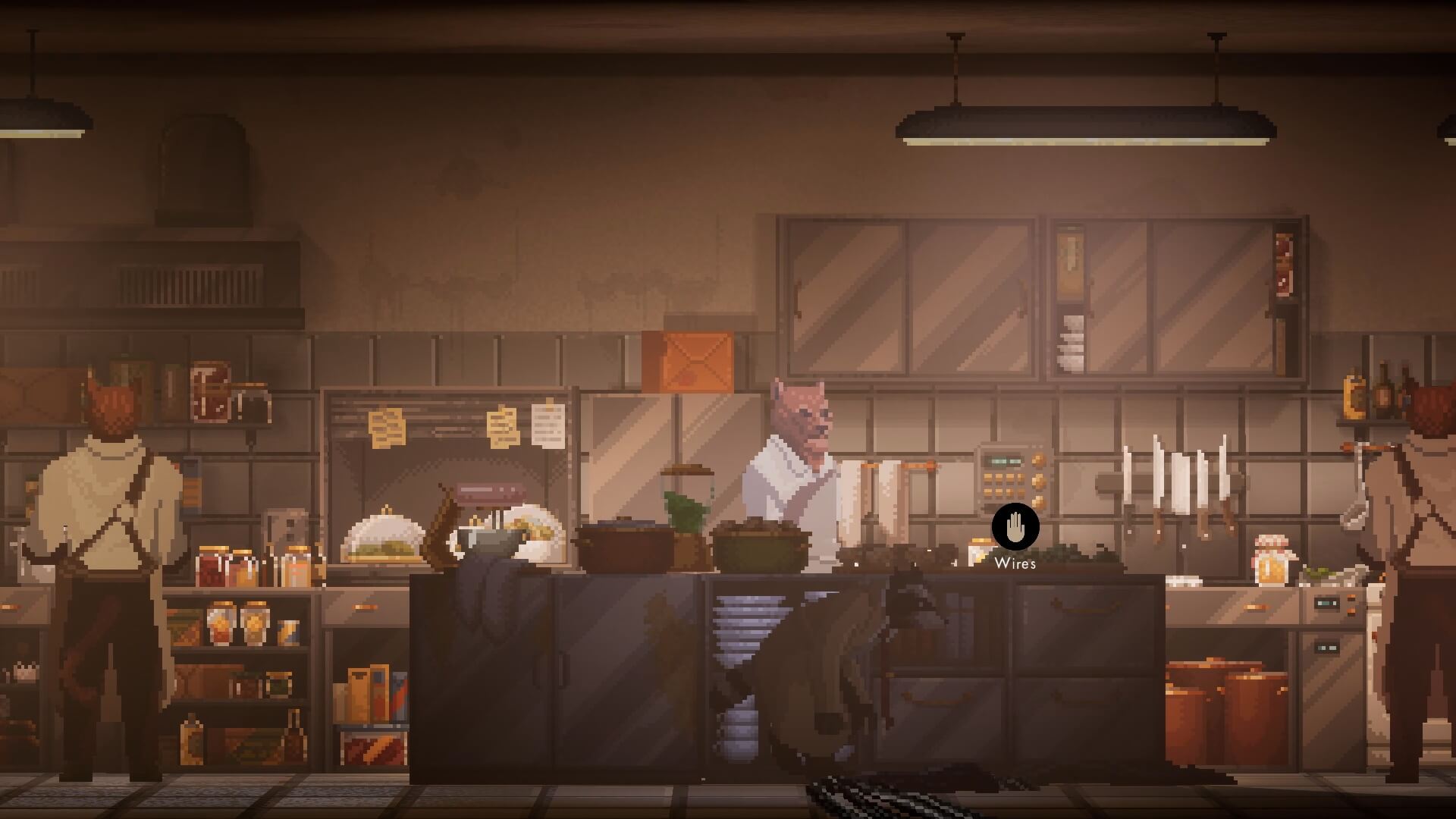
The single non-dialogue puzzle in the demo was a satisfying combination of physical arrangement and logic. While I won’t spoil the solution here, the answer is a clever nod to fans of immersive sims and brought a smile to my face.
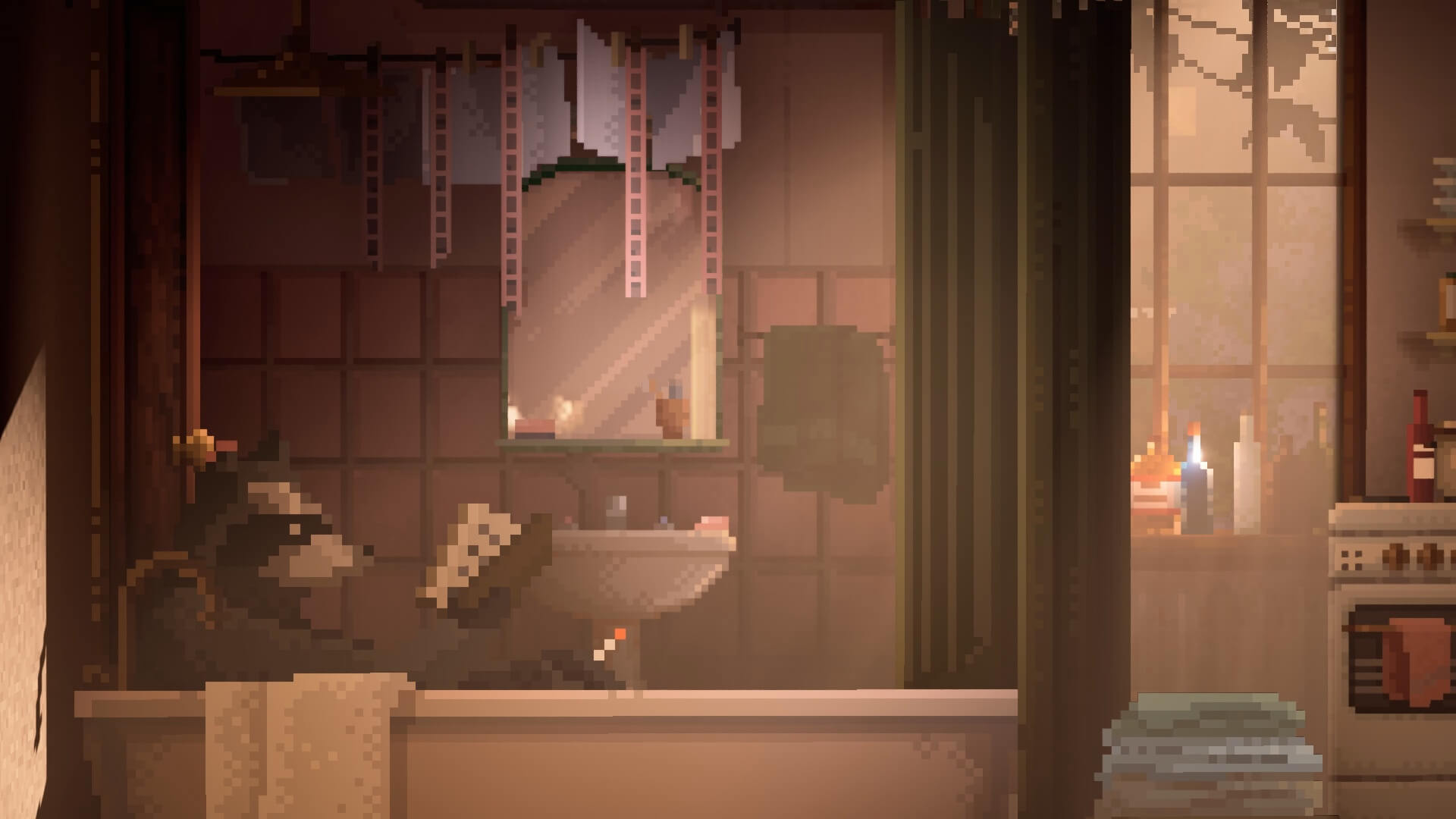
Overall, Backbone: Prologue is a game to watch – the novel combination of stealth and adventure combined with the imaginative setting is shaping up to win over adventure fans when the game releases next year.
- Chandon, also known as Bawss Sawss, is definitely not three raccoons stacked in a trench coat. He’s also a sauce aficionado, gamer, writer, musician, and one head of the 2 Headed Hero gaming channel on YouTube. He can be reached on Twitter, Instagram, or Facebook. NEW!! You can now directly email questions/concerns/playful insults to [email protected] !
- 2 Headed Hero’s quieter half, Rollinkunz, is the channel’s illustrator, gamer, writer, and boardgame designer, He can also be reached on Twitter, Instagram, or Facebook.
BACKLOG.TXT: Regular Human Basketball is 1-on-1, Human Style
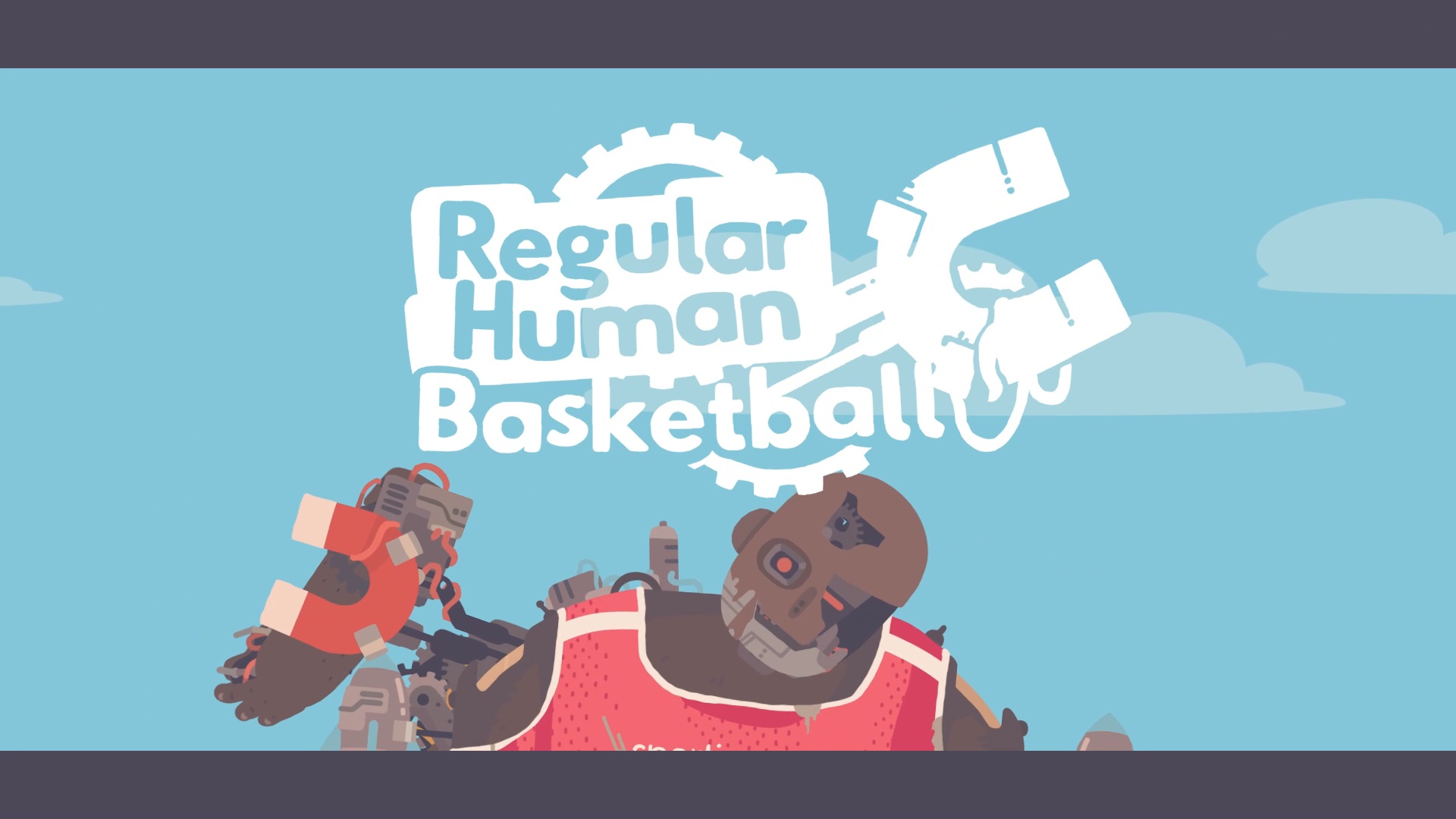
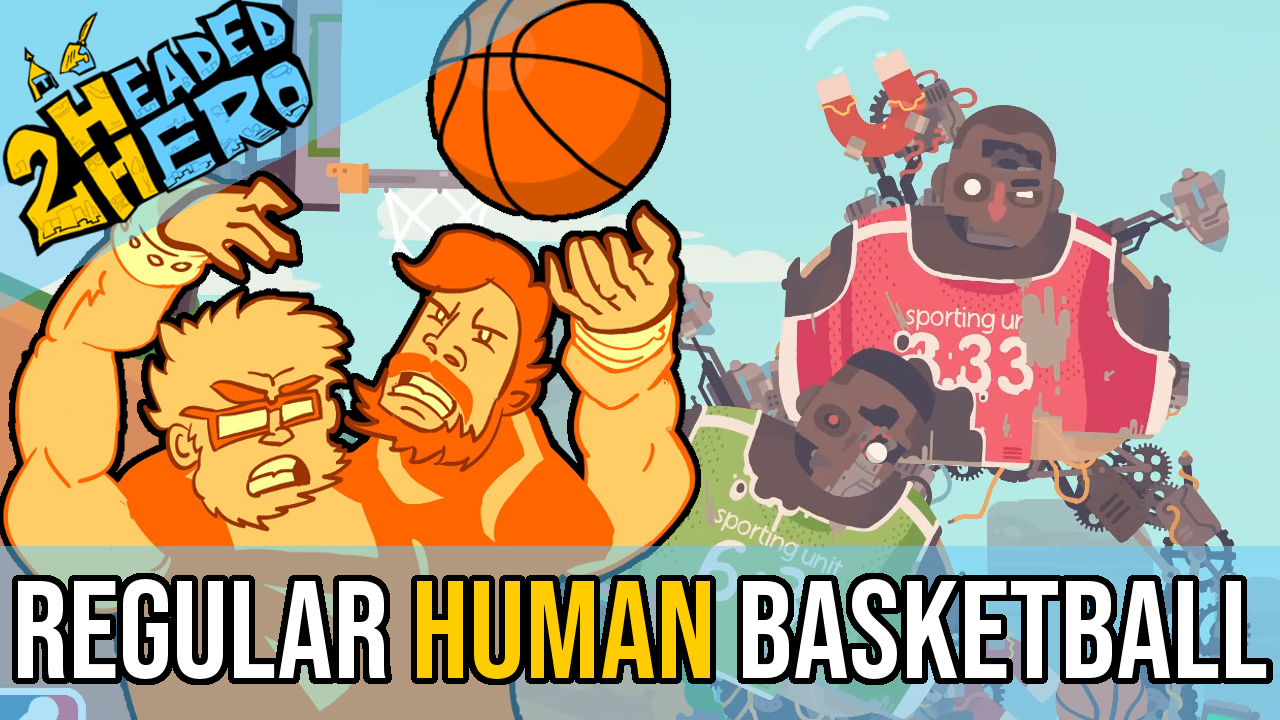
Previously on Backlog Quest, we took a look at Regular Human Basketball, which, as the title suggests, is a game about a couple of regular, average humans that are… definitely not robot suits controlled by tiny aliens… facing off with some one-on-one on the b-ball court. Prefer to watch? Check out the episode on the 2 Headed Hero YouTube channel!
Regular Human Basketball: Could It Be the First Entirely 100% Human Sports Game?
Regular Human Basketball is a multiplayer-focused competitive platformer and physics puzzler. This relatively new indie title, released on August 1, 2018, represents the second effort by the Australian two man team Powerhoof Games– the first being the rather novel 2017 dungeon diver Crawl.
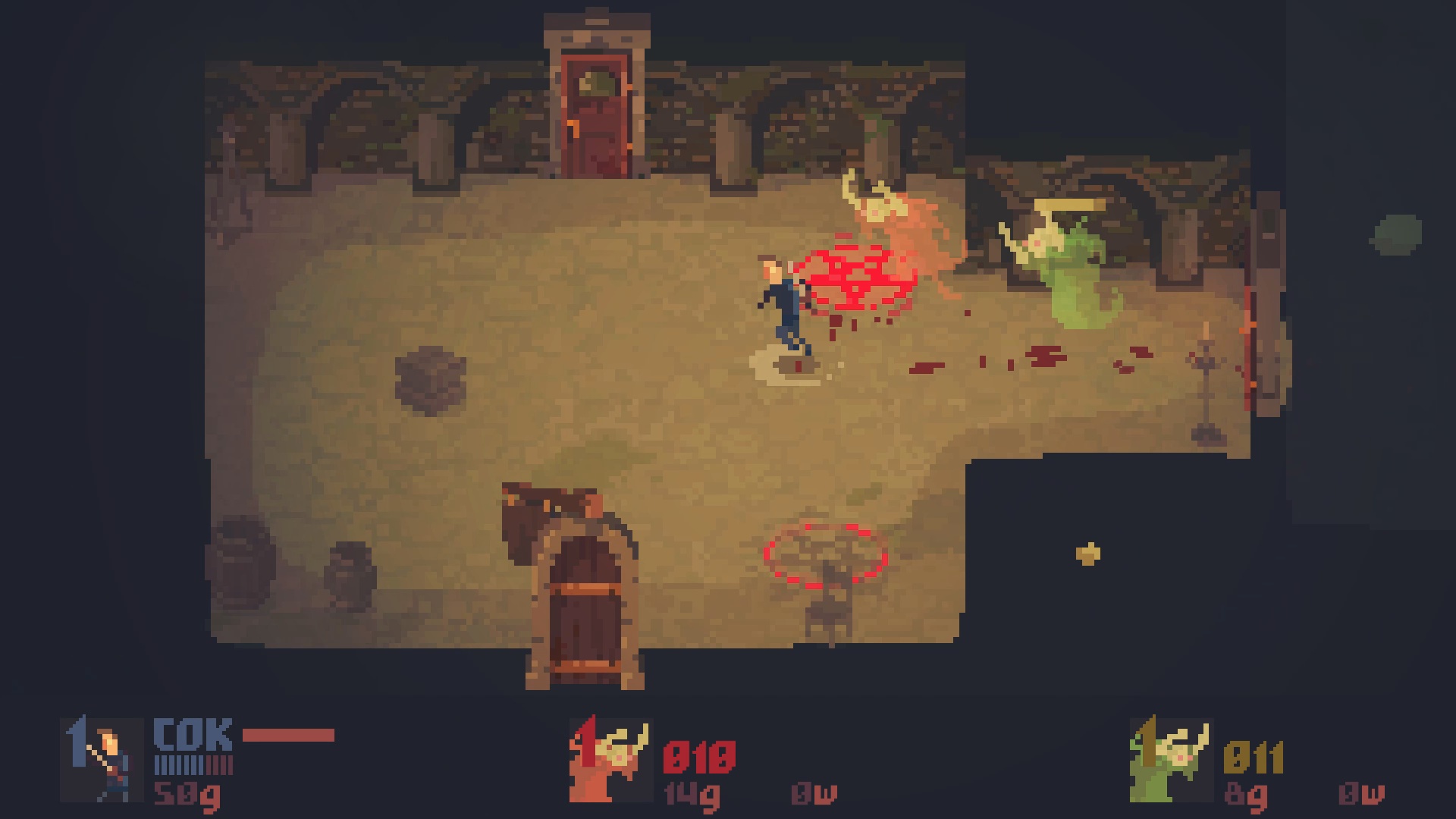
Both games feature detailed 2D art and a multiplayer focus, but this is where similarities end. Crawl focuses on a peculiar brand of competitive couch-only multiplayer with monster possession mechanics, king of the hill victories, and rampant hacking and slashing, with each player attempting to take down the leader in a battle for score dominance and bragging rights.
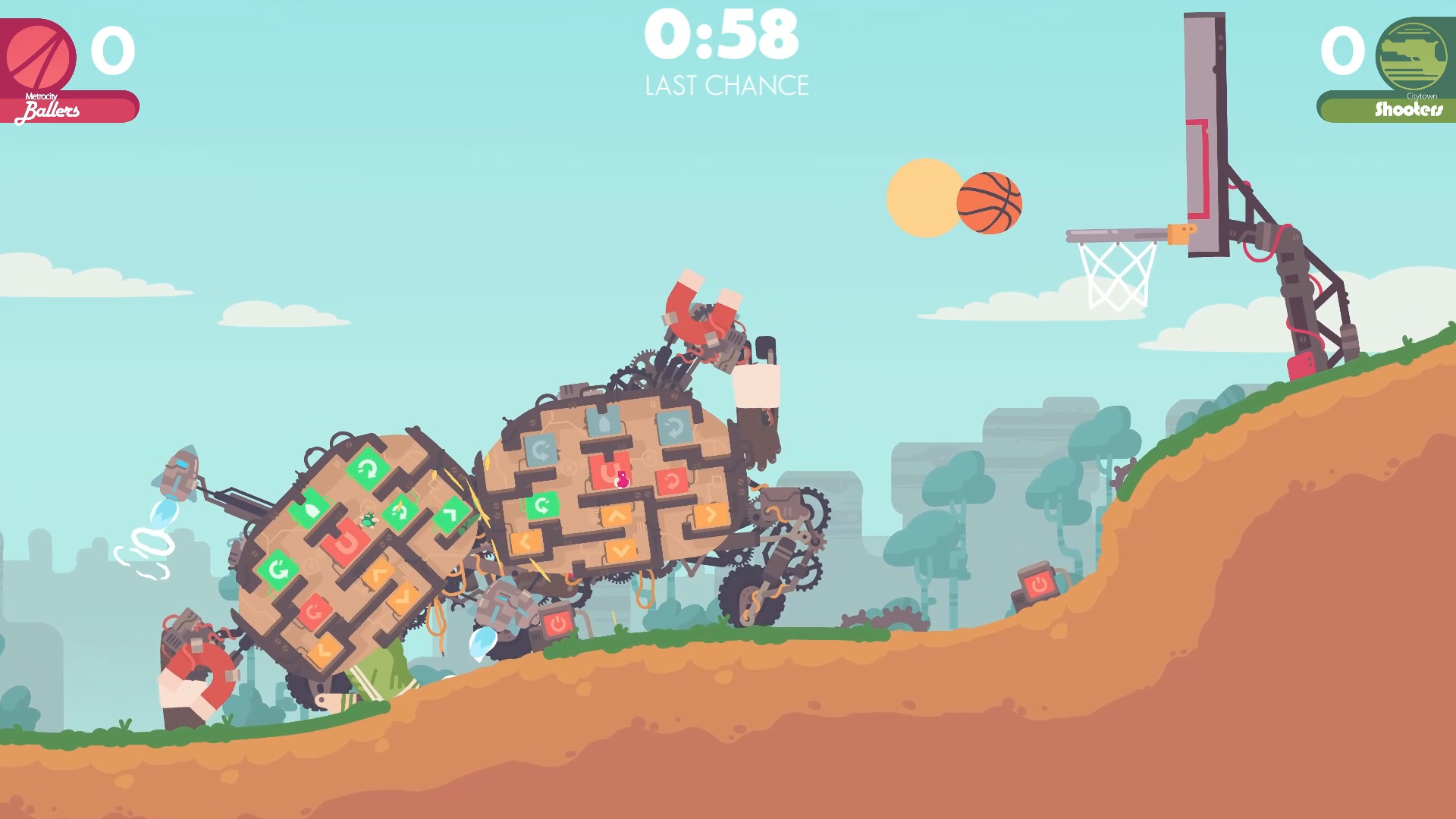
Alternative game title: Hoopin’ With Humans. Powerhoof, take note: I’m available as an idea man.
Healthy Regular Human Competition
In contrast, Regular Human Basketball takes a team-based approach. Two squads of up to five players each face off locally, or online, in a curious combination of platforming, wobbly physics, spirited competition and jolly cooperation. The goal? To see which of their “humans” can dunk-em-up the most before the end of the match.
Rather than directly controlling the “human”, players instead take on the roles of tiny, fragile aliens that can easily be crushed by the basketball itself.
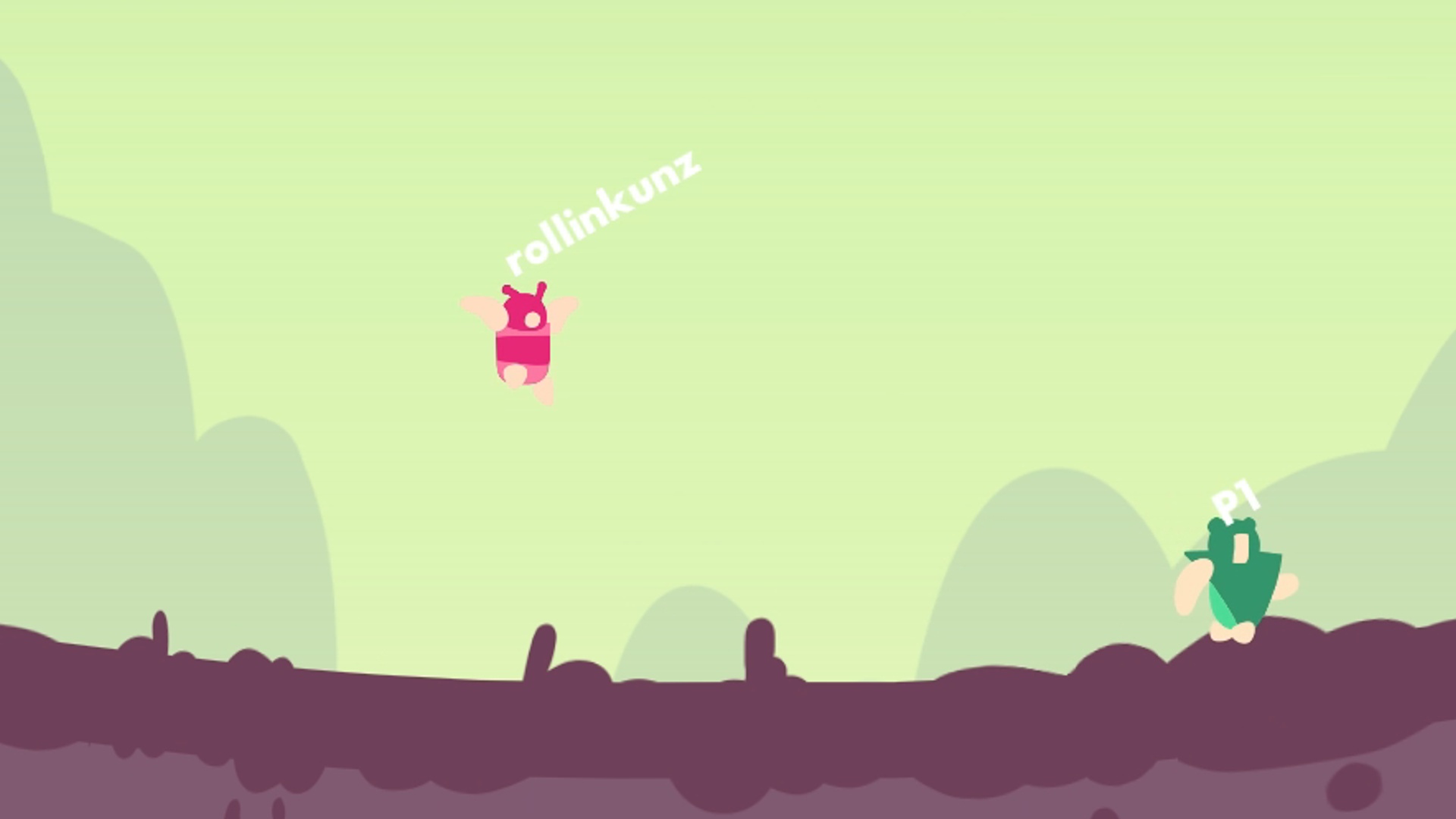
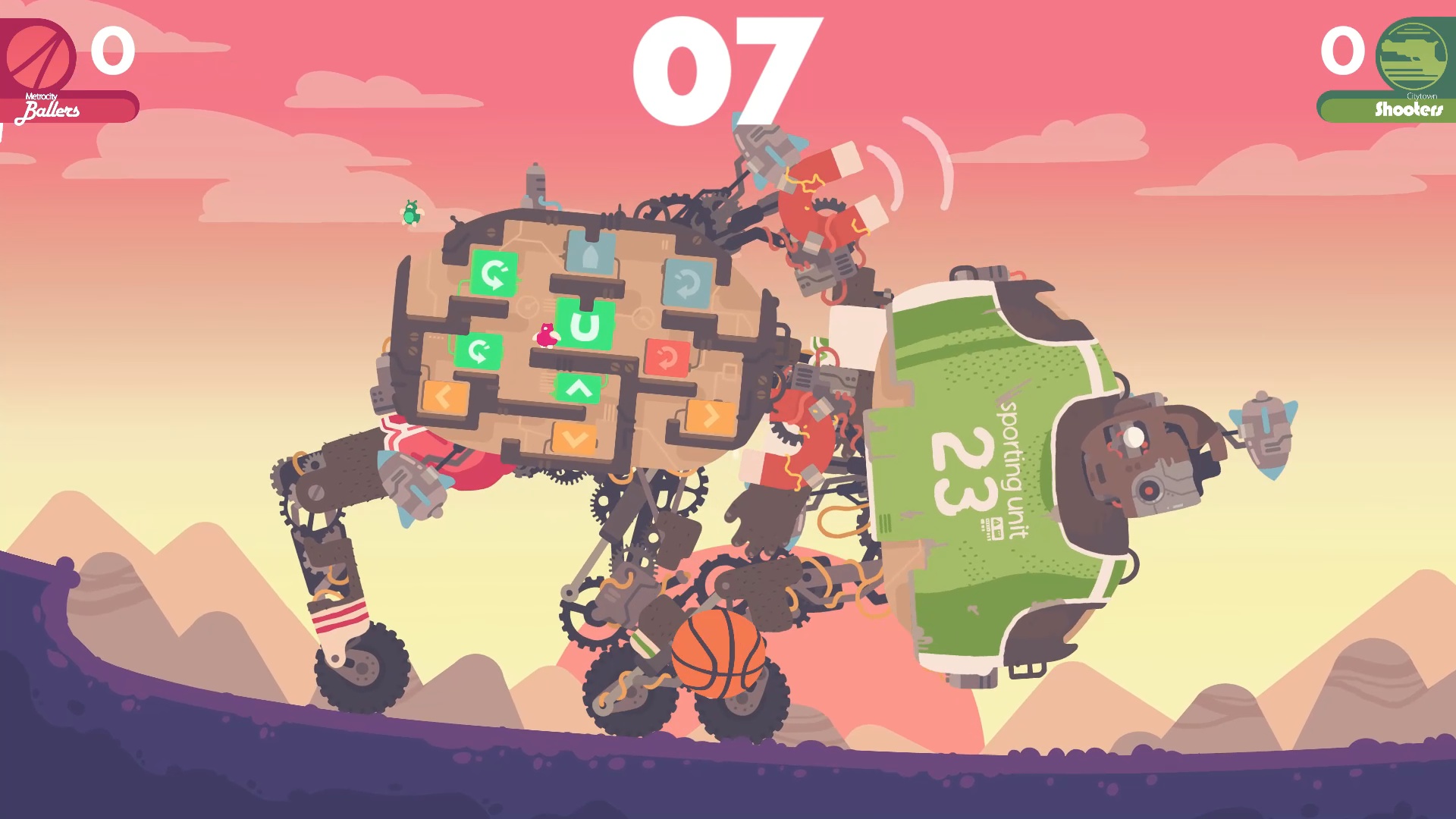
These itty-bitty ETs jump inside of the “humans” in order to aim their boosters, swing their magnets, and put their wheels into gear.
All this is accomplished by manipulating various switches inside the “human”. Therefore the path to victory can be a challenging and often hilarious one, as players have to master a combination of frantic multitasking and concise timing, all while anticipating the movements of both your own “human”… and your opponent’s.
True Touches of Humanity
Rounding out the game’s clean and attractive visual presentation are a few other clever touches. There is a small selection of courts to choose from, each with different terrain or features to help mix up the matches. The sound design here is also really solid, containing the clanks and clunks of colliding humans and rebounding b-balls. The bouncy 80s-style hiphop soundtrack is often hilariously punctuated by the giggle-worthy outbursts of a couple regular “human” announcers.

The real icing on the cake is the absolutely wonderful fast-time instant replay feature – watching one “human” triumph with a buzzer beater or boost dunking high above an opposing team’s head is just… simply… magnificent.
Praising Regular Human Innovation
I can appreciate a good concept in gaming. Praising innovation is something we often strive for throughout our never-ending Backlog Quest, and Regular Human Basketball simply exudes creativity. Its presentation is funny and endearing, its controls are simple to learn but hard to master, and despite the very occasional lag spike or disconnect, the game ran well.
Still, I unfortunately had a rather frustrating time with Regular Human Basketball. I just could not seem to get a good enough handle on the mental gymnastics required to succeed, or even legitimately score, in a single one on one match.
Examining Games I Suck At Playing: An Important Realization
When putting a game under the microscope, it’s important to create some distance and objectivity and realize that sometimes it’s not the game that’s at fault, but the player. When I run into a title like this, where I can see all this the potential fun lurking beneath the glass but can’t touch it for the life of me, it’s both frustrating and heartbreaking.
Unfortunately, Regular Human Basketball‘s main issues lie with its lack of marketing and near-silent launch.
Some of the issues I found with the game are not without merit, however. Player base is the lifeblood of any multiplayer game, and the Achilles Heel for Regular Human Basketball – almost no one is playing this game. After the initial hilarity factor wore off and we sat in the barren matchmaking trying to team up for a two on two for far too long, I couldn’t help but repeatedly think how much more fun could be had with Regular Human Basketball if it had the player base to support its ambitions, or even an option to play cooperatively against bots.
Regular Human Value
Regular Human Basketball has a simple creative charm that got a lot of laughs out of me, despite my inability to even master its basic strategies. This game would be the perfect timekiller with a group of friends. Passing out controllers on the couch in front of Regular Human Basketball would definitely set a great and goofy tone while waiting for your cab to show up before a night on the town – or even later on during that same night, after waiting for that necessary post-crawl pizza delivery.
Regular Human Basketball is quite a good, polished deal for its $4.99 asking price, better if you have a pile of controllers and a TV handy. Although it might not be the preferred flavor for this gamer, I respectfully give this game a salute of my sweatband.
- Chandon, also known as Bawss Sawss, is a sauce aficionado, gamer, writer, musician, and one head of the 2 Headed Hero gaming channel on YouTube. He can be reached on Twitter, Instagram, or Facebook.
- 2 Headed Hero’s quieter half, Rollinkunz, is the channel’s illustrator, gamer, writer, boardgame designer, He can also be reached on Twitter, Instagram, or Facebook.
Vaporum: Rapture By Degrees | BACKLOG.TXT
Tighten up your bolts and hold onto your top-hats: today’s Backlog Quest focuses in on Vaporum: the journey of an amnesiac pest-control professional. Prefer to watch? Check out the video breakdown at the link above, or visit 2 Headed Hero on YouTube!
Vaporum: Rapture In 90 Degree Increments
Vaporum is another entry into the growing revival of new indie grid-based dungeon crawlers. This genre has deep roots, reaching all the way back to the graph paper beginnings of RPGs themselves, and many old grognards still carry fond memories of titles such as Eye of the Beholder. One of my all-time favorites, Lands of Lore: The Throne of Chaos, remains enjoyable even to this day.
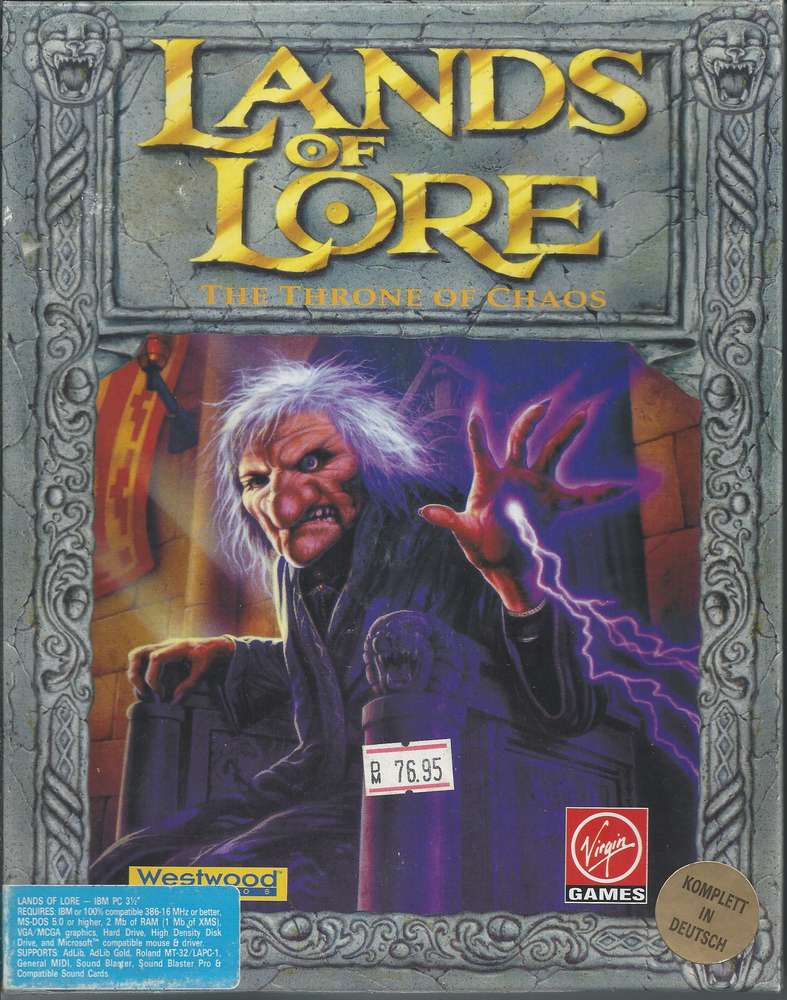
The humble beginnings of the grid-based dungeon crawler now see new life due to an explosion of indie titles.
The genre went back underground following the onslaught of first-person shooters, seeing few releases of note for several years. That is, until the 2012 indie title Legend of Grimrock reignited interest in this particular style of gameplay. Grimrock opened the floodgates for dozens of similar grid-based CRPGs in the indie gamespace.
Vaporum is a 2017 entry into the rediscovered realm of dungeon crawlers from small Slovakian developer Fatbot Games. Over the last couple years, the game has undergone many improvements, and has now found a new life on consoles. This week brought us console releases on Xbox One, Playstation 4, and the Nintendo Switch. So – how is it? Let’s lace up those corsets and dig right in.
Full Steampunk Ahead
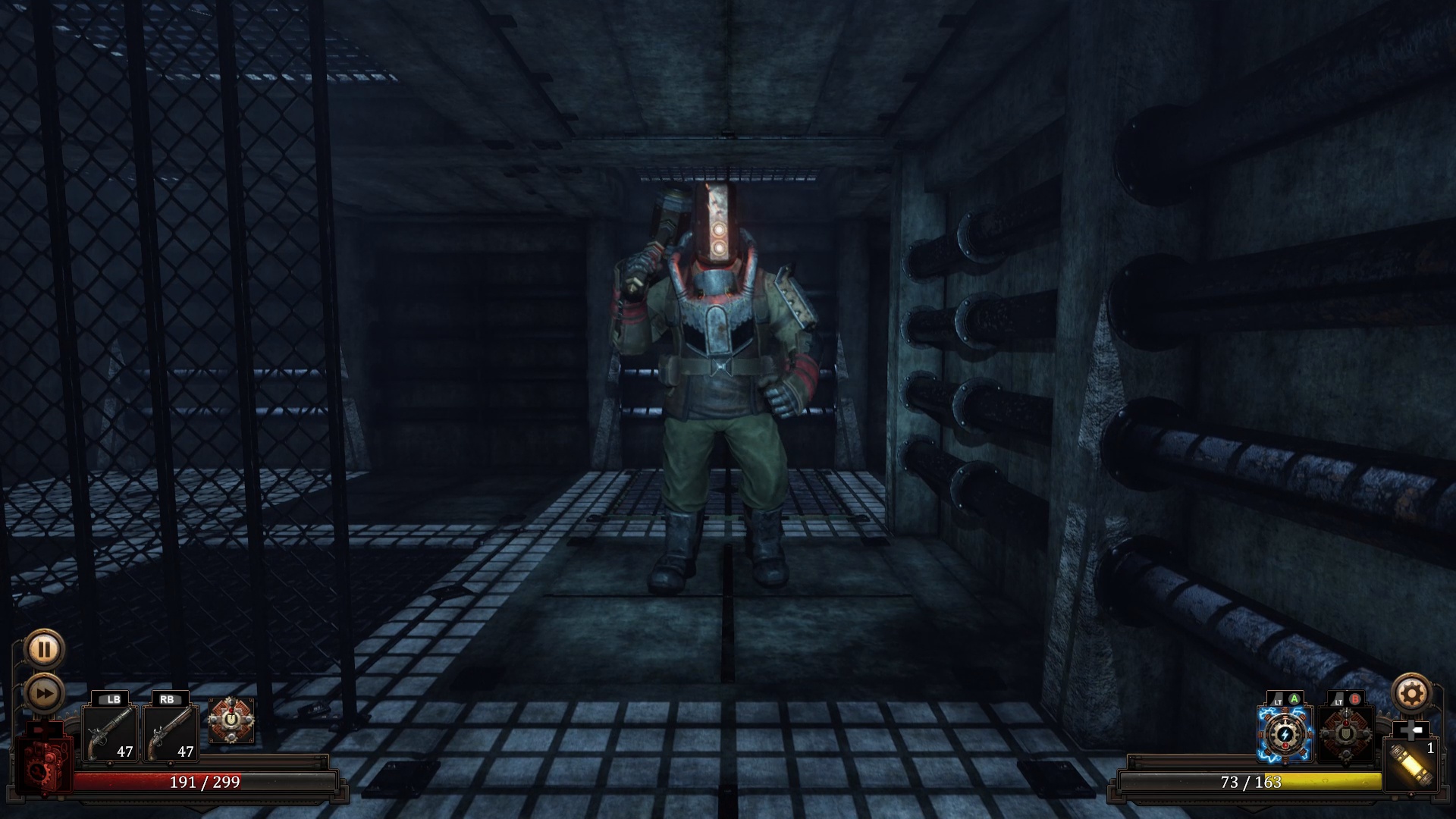
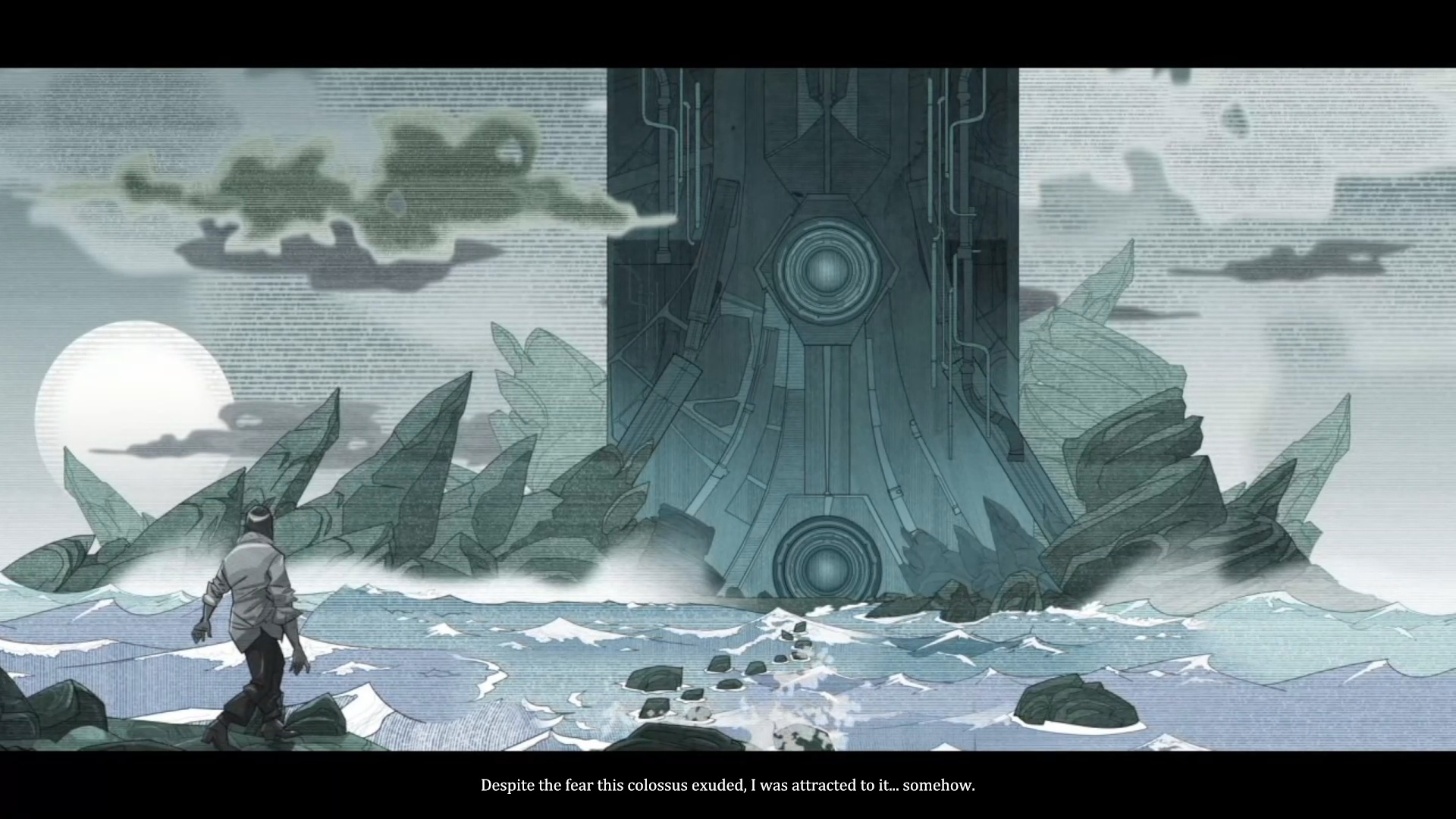
Rather than controlling a party of adventurers, Vaporum players are stuffed into the clanky brass boots of a single survivor. After waking up on a particularly cozy patch of wet rocks, our intrepid roach-wrecker realizes he has a clear choice to make: either step inside the doors of this unwashed mechanical nightmare, or await a murky death at the bottom of the sea.
Our mouse-mashing hero proceeds to double duty as the titanic tower’s handyman- rearranging cargo, fixing engines, and eradicating various other OSHA hazards throughout his journey. At every turn, he battles a variety of horrific delusions: overgrown cockroaches, bloodthirsty spider-toasters, and even the odd psychotic lamp. Truly, Vaporum aims to place the player face to face with the terrifying repercussions of a massive memory-loss-causing head wound.
During the game’s tutorial, you strap yourself into one of four different work rigs, roll up your cummerbund, and get to work. Combat generally plays out in real-time, with actions, movements and attacks having both a wind up and a cooldown, but the action can be paused at the tap of a button when encounters get hot.
Stick It To Em
The addition of native controller support is an excellent one. Since Vaporum lands squarely in a genre long dominated by keyboard and mouse controls, I was blown away by how well this works. Left Trigger is mapped as a sort of modifier key for major functions, and Right Trigger brings up a free cursor to help suss out secret buttons and levers. Inventory management is also fairly minimal. Grid movement on a joystick can feel a little strange at first, but once accustomed to it, you’ll be flying down Vaporum’s rusty hallways and sidestepping its angry denizens with ease.
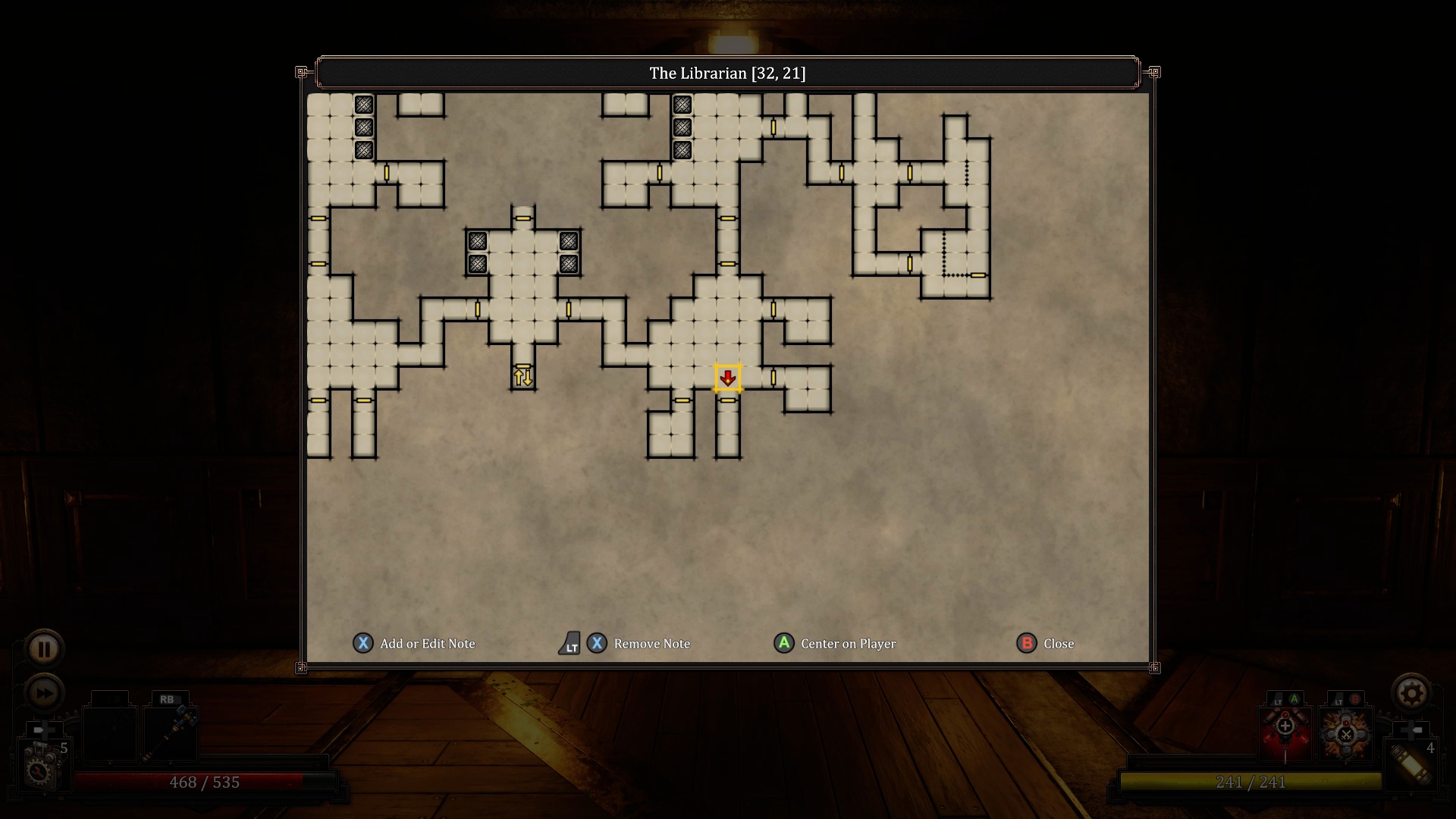
Navigation isn’t all sunshine and rainbows. Vaporum completely lacks a compass, and the automap feels pretty bare-bones. Even the creaky old dungeon crawlers it emulates had better versions of these features. As it is, players might find themselves referring to the map pretty often, which can break up the action.
Down to the Nuts and Bolts
Visually, Vaporum approaches style over realism. I mean, we are talking about a fantasy steampunk horror setting, here. There’s a good amount of detail in the environments. Various valves and other greebles line the walls and help bring the setting to life. The odd stray toolbox, forgotten book, or discarded trinket gives the game a lived-in look. There’s a few lackluster textures here and there, but the style is quite cohesive – even if it can be a bit dark.
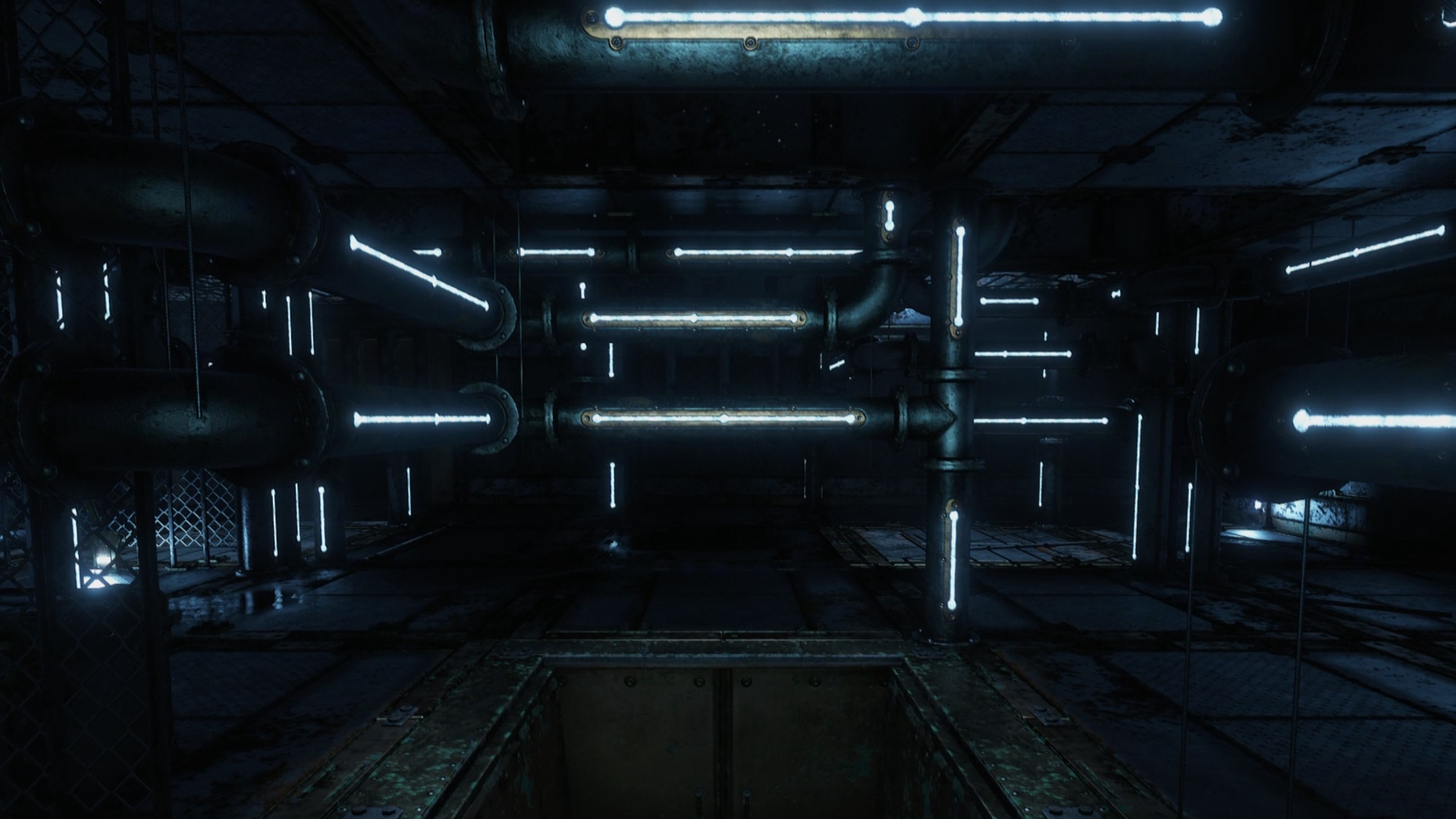
Enemy models have some unique designs that fit the theme, sporting brass cogs and smoking furnaces galore. There’s occasional stiff animations when an enemy is moving, likely exacerbated by Vaporum’s grid-based movement system. It would have been nice to have some sort of swinging animation for the weapons rather than just the white streak that flashes across the screen, but this is a pretty common approach to weapon animations in crawlers of this caliber – and overall a small nitpick.

On the sound side, Vaporum has fairly adequate effects. There’s a satisfying clang when club meets automaton, or when your rig gadgets send forth waves of lightning. Music is nearly nonexistent, save for some industrial noise track during boss fights and a very catchy main menu song. This subtle approach definitely lends itself to the horror overtones, but I still would have liked a little more mood music.
The game also contains a fairly large amount of voicework throughout its short length. Most of these reside in the internal dialog of the player character, and audio logs that litter the environments (as seen in Bioshock or System Shock). The voiceover work serves to add a step of polish and immersion, and helps Vaporum rise above the normal expectation of a small-team indie game.
Vaporum Skill Emporium
First and foremost: this game will wreck you. Even on Normal difficulty, players are going to be tested. Each enemy encounter can easily bring your hapless handyman to his knees, or drain your scarce resources. On the bright side, there’s numerous difficulty settings, including a casual mode that makes combat completely trivial and allows Vaporum to be completed as a puzzle game.
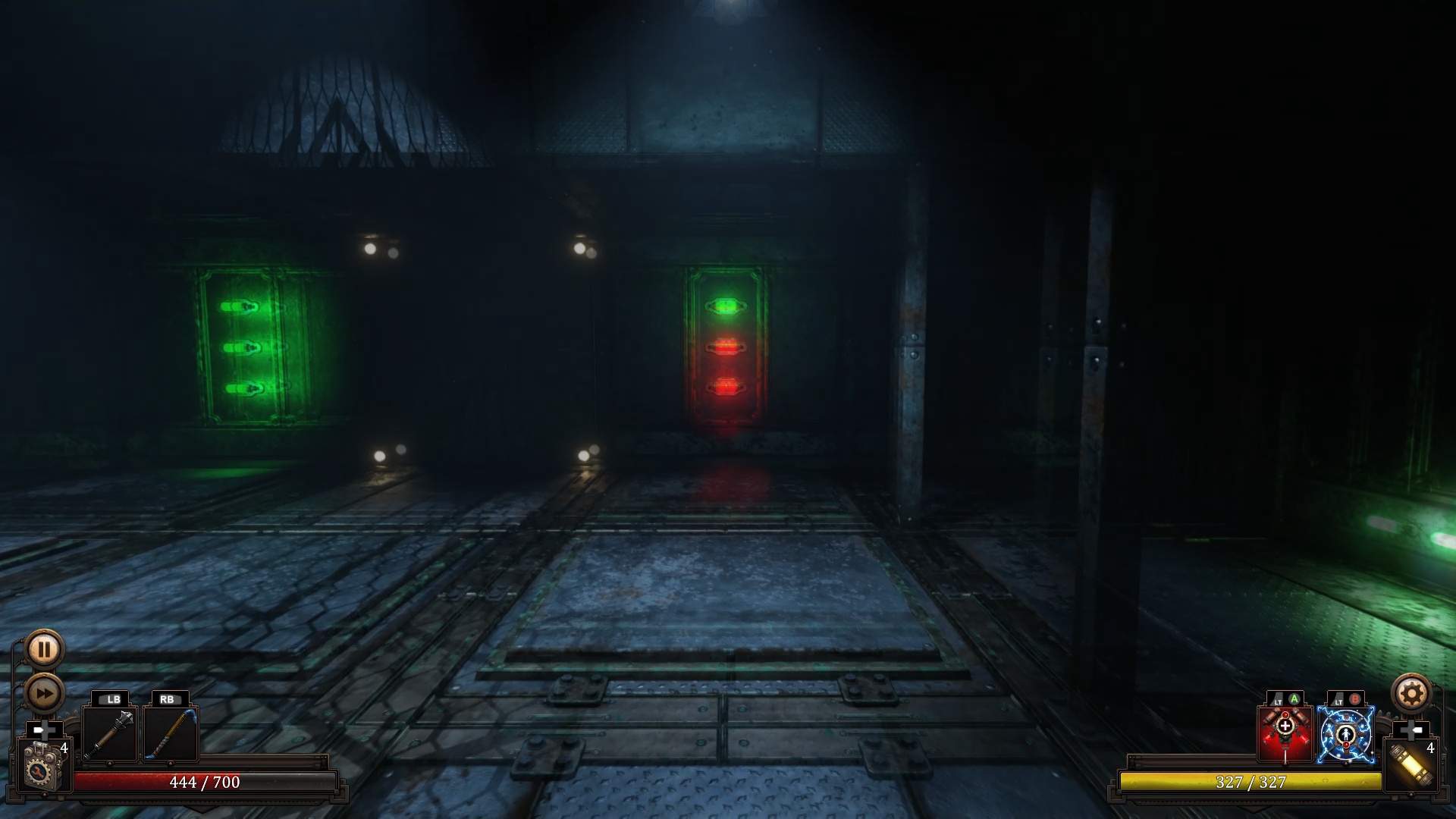
Several of Vaporum‘s devious riddles stand between you and the top of the spire. While most of these are well-constructed and enjoyable, several involve some tedious crate-pushing. For me, the box shoving puzzles were the most frustrating, and brought the game’s pace to a crawl.
On the bright side, many of the levels also contain secrets (and some contain secrets within secrets), which is naturally where all the best stuff can be found. The completionist in me felt compelled to poke and prod at the game’s dark corners in search of hidden switches and concealed treasures – well worth it considering the risk that combat presents.
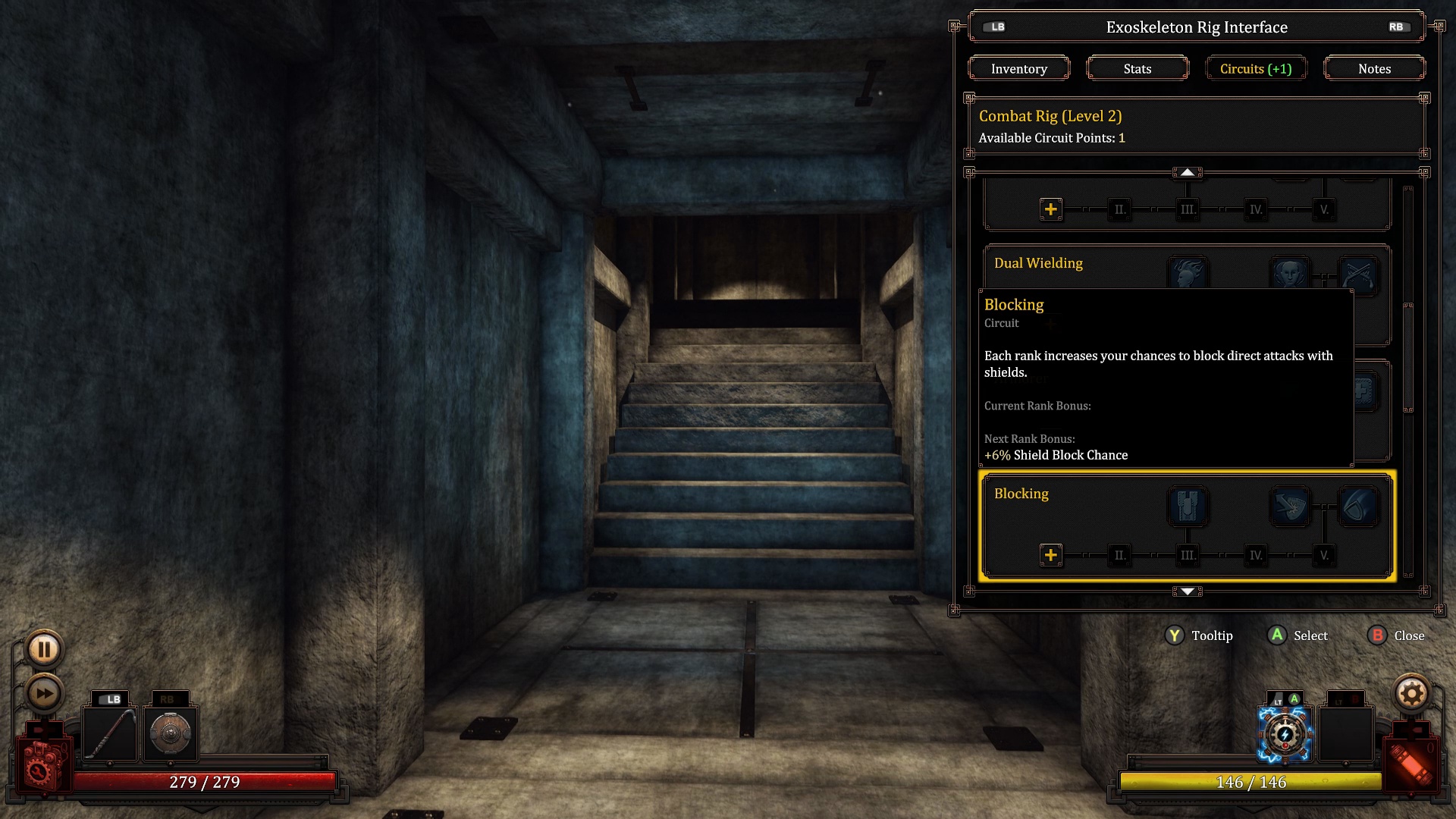
Vaporum has a heaping amount of skill trees to focus on, and the early choices are the most important ones. You’ll need to zero in on one or two trees at most, and at least one of those should involve survivability. I loved how the skill bonuses gave out some nice meaty numbers, making it feel like an accomplishment upon level up. Unfortunately, Vaporum keeps with true old-school design and offers no respec option, so be warned: you’ll be forced to live with your choices.
Bot Bashin’
Once I gained enough experience – uh, “Fumium” to flesh out my rig build, the combat became pretty enjoyable. I went with a dual-wield build, and two-fisting flintlocks or pummeling the various bots and abominations with clubs and crowbars was pretty satisfying. The enemies tend toward damage sponginess, but encounters are normally small. Therefore, you’ll have to learn to sidestep your way around combatants to defeat them with a sound combination of positioning, attacks, and ability use.
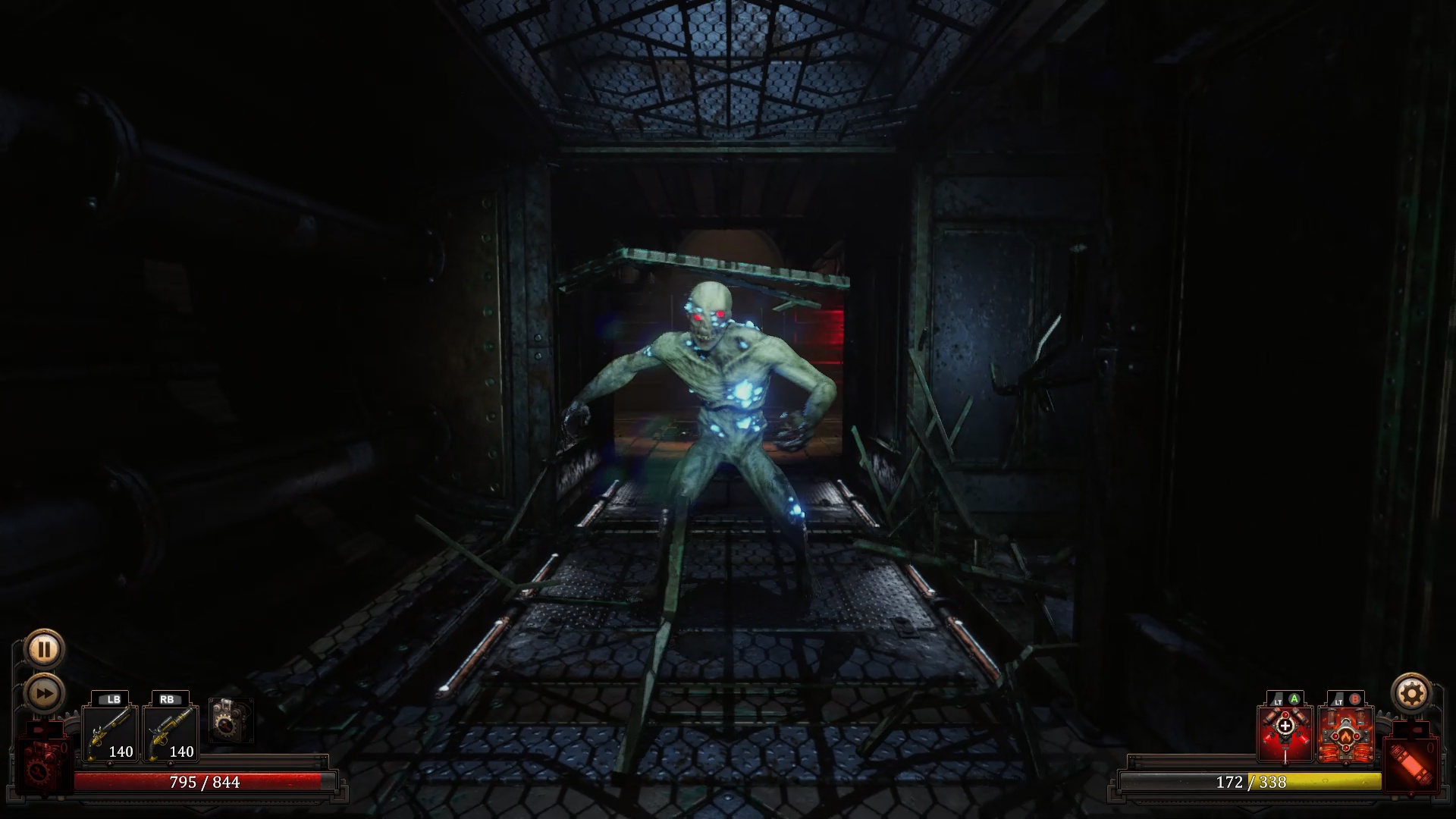
Oh Heal No
Much of Vaporum’s challenge lies in the lack of healing skills. Repair kits are hidden in the levels or dropped by enemies, but are precious few. Abilities can be attained in the mid-game to drain life from foes, but the risk of combat must be weighed carefully. Unlike many old-school crawlers, there’s no rest feature or healing spells. By leaning on puzzles and exploration and making battles risky, Vaporum has much more in common with survivor-horror game mechanics than it does with the dungeon hacks of old.
Vaporum Escaporum
While it’s easy to dismiss 2017’s Vaporum as another “me-too” entry, Fatbot Games has taken heavy strides to differentiate their dungeon diver from the growing pack. Vaporum leans towards a Lovecraftian survival-horror approach, and coats it in a grimy steampunk veneer. For those looking to face down armed automatons and brutal behemoths within a labyrinth of perplexing puzzles, this is a solid choice. And for those that are looking for a challenge, they will certainly find it here.
- Chandon, also known as Bawss Sawss, has an embarrassingly large Steam library. He’s also a sauce aficionado, gamer, writer, musician, and one head of the 2 Headed Hero gaming channel on YouTube. He can be reached on Twitter, Instagram, or Facebook. NEW!! You can now directly email questions/concerns/playful insults to [email protected] !
- 2 Headed Hero’s quieter half, Rollinkunz, is the channel’s illustrator, gamer, writer, and boardgame designer, He can also be reached on Twitter, Instagram, or Facebook.
BACKLOG.TXT – Abyssal Somewhere is a Dream of Ruin
Abyssal Somewhere: A Brief Walk Through a Dream of Ruin
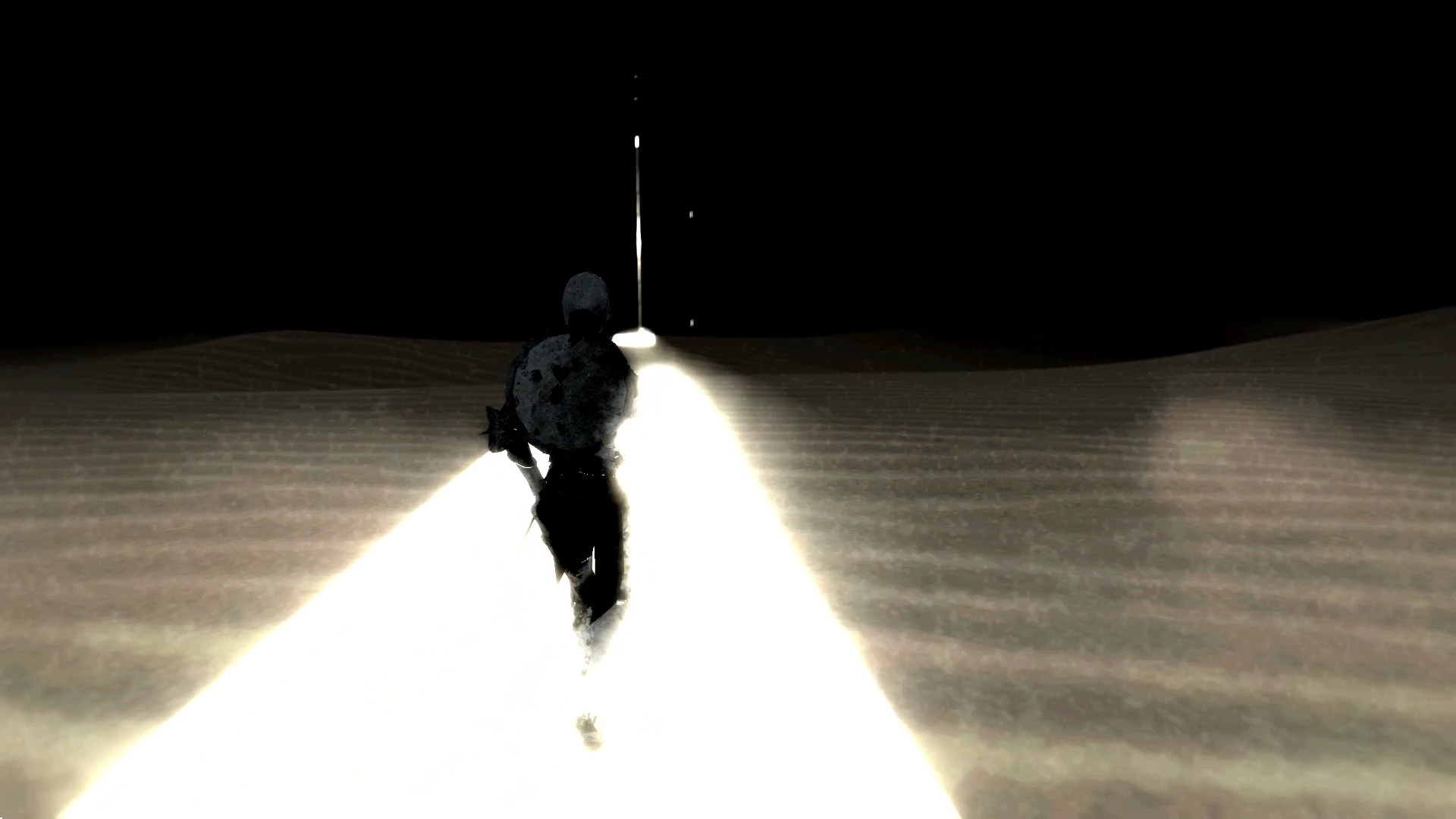
Half drunk and on a late night trip down a Twitter hole, I found myself face-to-profile with @_nonoise, an indie developer from Spain. As I scrolled down, this promo image, right here, grabbed me.
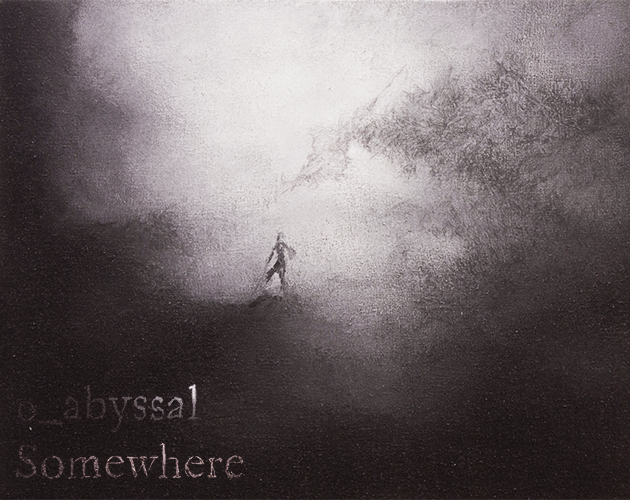
Consider my interest piqued.
I had to know more about this mysterious game. What was it? Some kind of Dark Souls-like RPG? Some kind of horror game? Well as it turns out, Abyssal Somewhere (or is it 0_abyssal Somewhere?) is more of a short, unnerving, somewhat mysterious experiment in adventure.
Alternative games can be hit and miss, instantly turning off some players with their non-standard mechanics and rough edges, but on occasion you find some that truly capture raw emotion. A great example of this was YouTuber-turned-gamedev 98DEMAKE‘s OK/NORMAL.
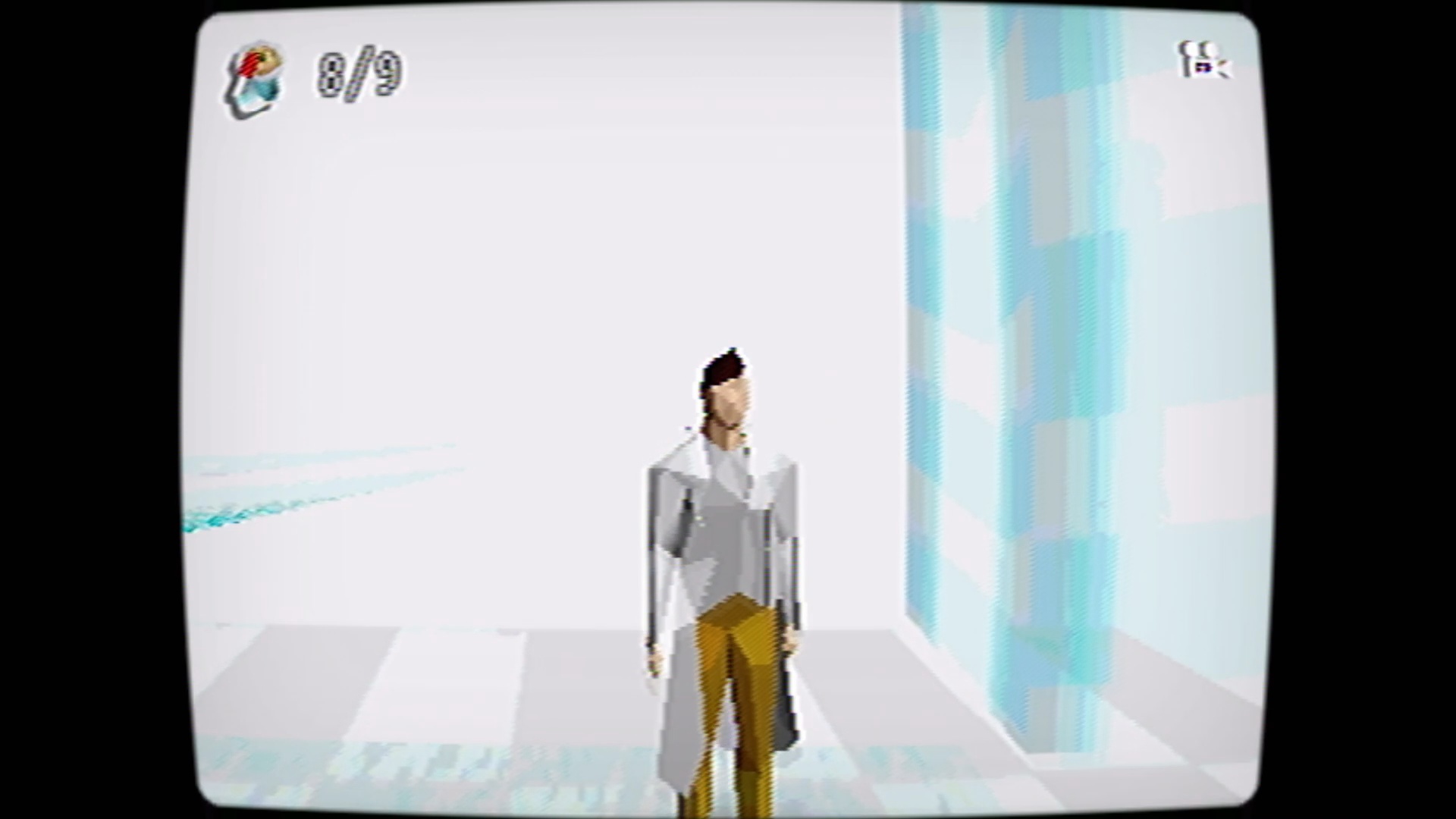
98DEMAKE’s experimental platformer OK/NORMAL was one of the first games covered on Backlog Quest back in June.
Abyssal Somewhere: Creeping, Noisy Dread
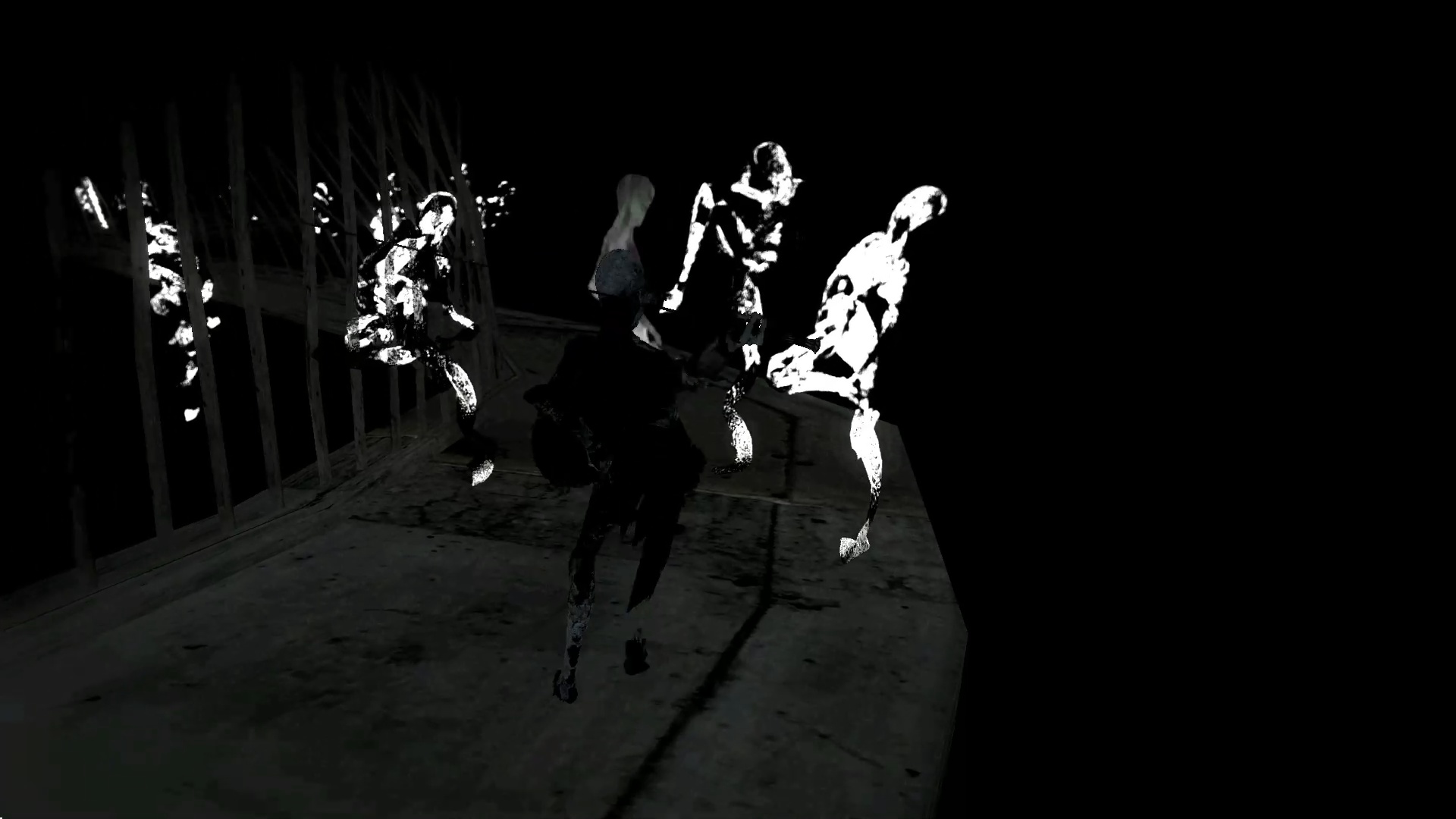
Or, a game about throwing shade(s).
OK/NORMAL managed to successfully capture despair, frustration, anxiety and depression within its 5th-generation console look and feel. In contrast, Abyssal Somewhere instills feelings of isolation, creeping dread and bleak curiosity that calls back to an old FROM Software favorite of mine, King’s Field.
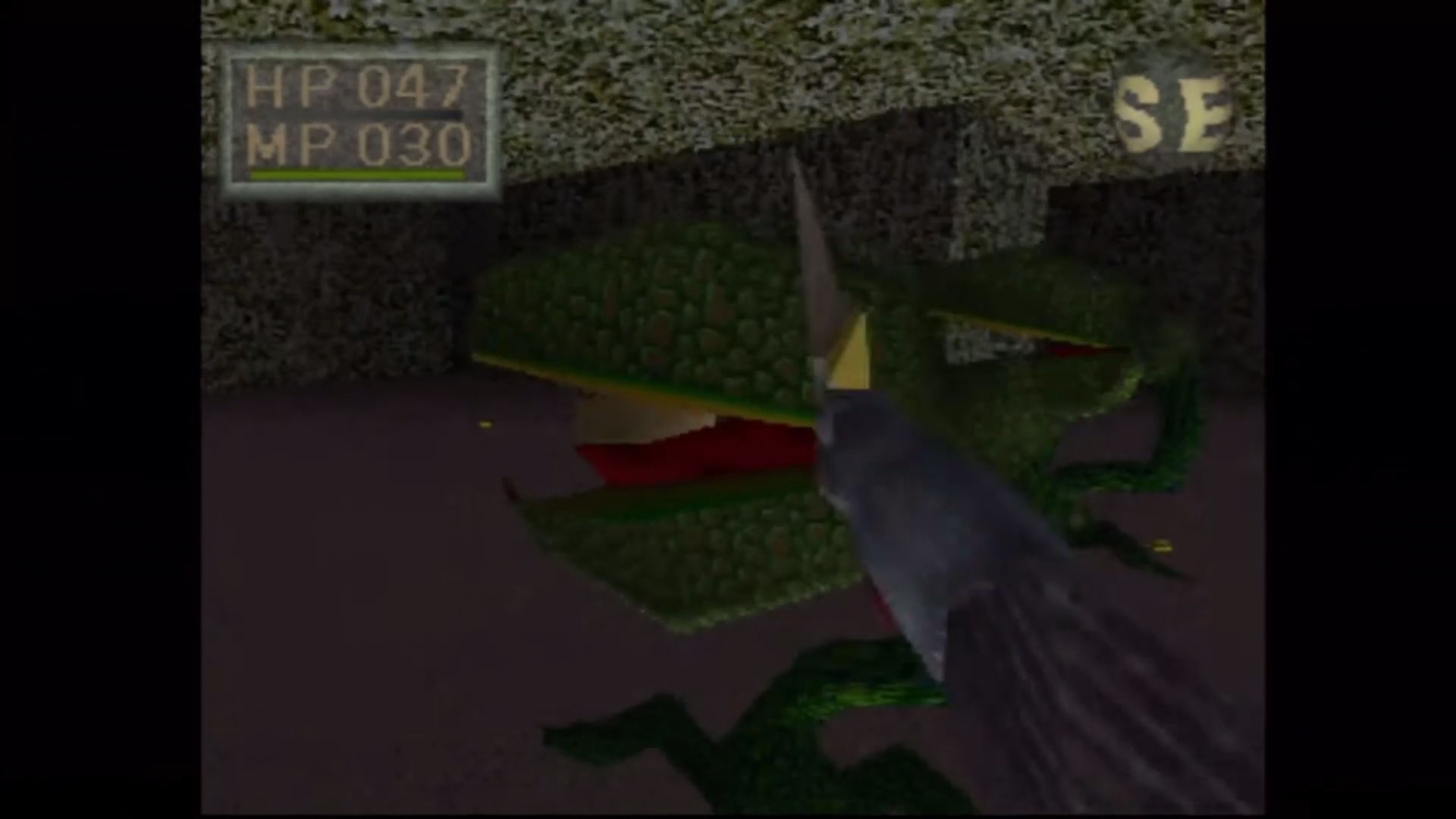
Abyssal Somewhere begins by throwing players onto a cold tile floor. As their vision clears, they awaken in the rusty steel-shod boots of a nameless, duckbill-helmeted knight. At first glance, players are provided little direction other than the occasional tutorial prompt, leaving it up to them to unravel the game’s mysteries. Instead, Abyssal Somewhere leads the player visually by drawing their eye to its points of interest with the clever use of light and darkness.
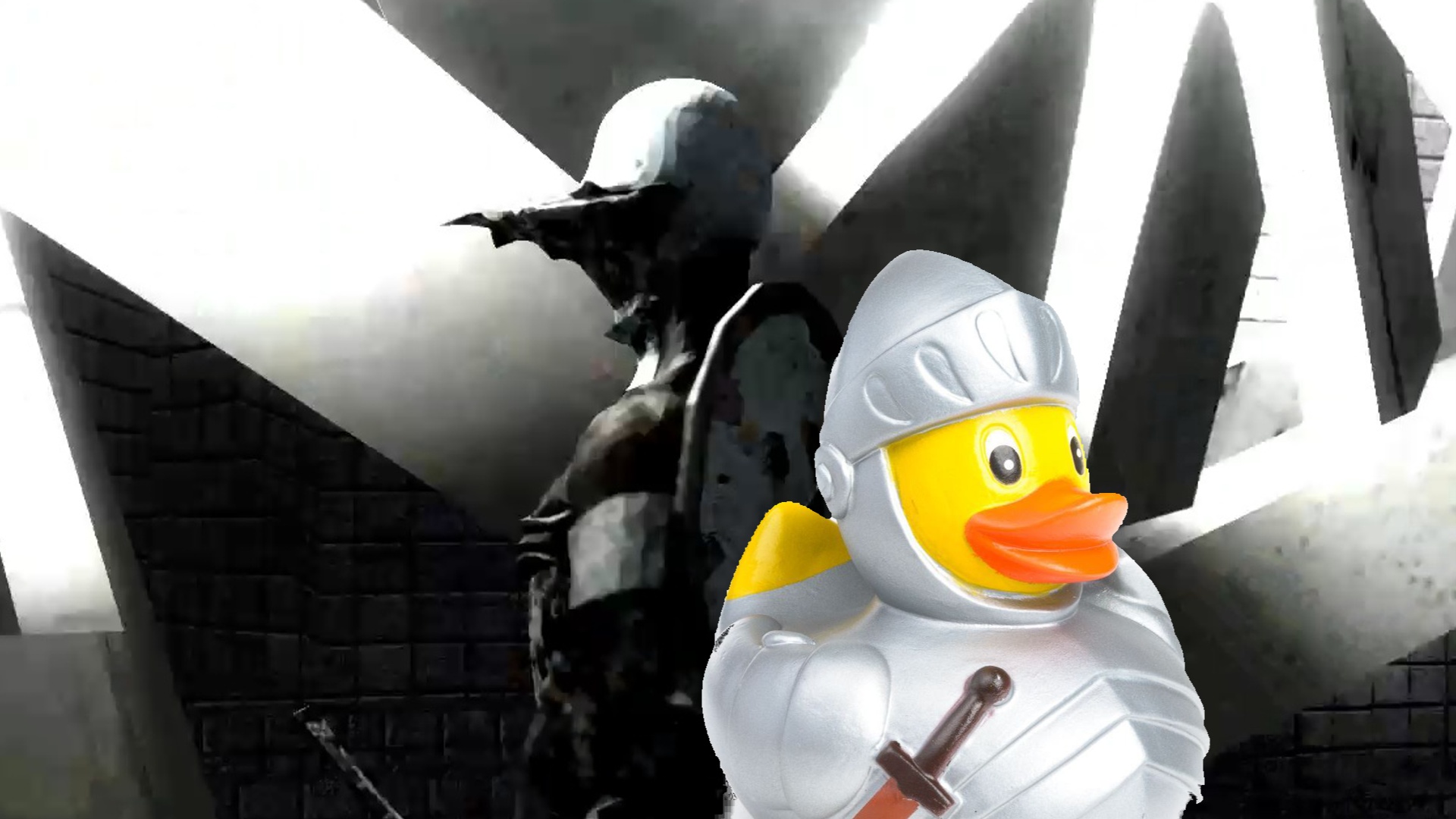
The Duck Knight rises.
While a bit reminiscent of the Souls or King’s Field series, interesting use of bloom, filters and low-res textures give Abyssal Somewhere a look and feel all its own. The animations of the enemies and shades that obstruct your journey also have an effectively creepy and disjointed feeling.
The sound design ranges from subtle and atmospheric to harsh and noisy. Distorted melodies play out during certain key story points, and even more mundane things like opening a gate caused my arm hairs to stand up. Overall the sound design was rough but effective, and meshed with the equally-distorted visual style quite well. The one thing that I felt could use improvement was the knight’s footstep noises. Since it seemed like they were rather repetitive and based on one repeatedly pitch-shifted sample, they tended to stick out. The game’s itch.io page also warns of loud, sudden noises, but I didn’t find anything excessive that blew out my headphones.
Show Vs. Tell: The Value of Environmental Storytelling
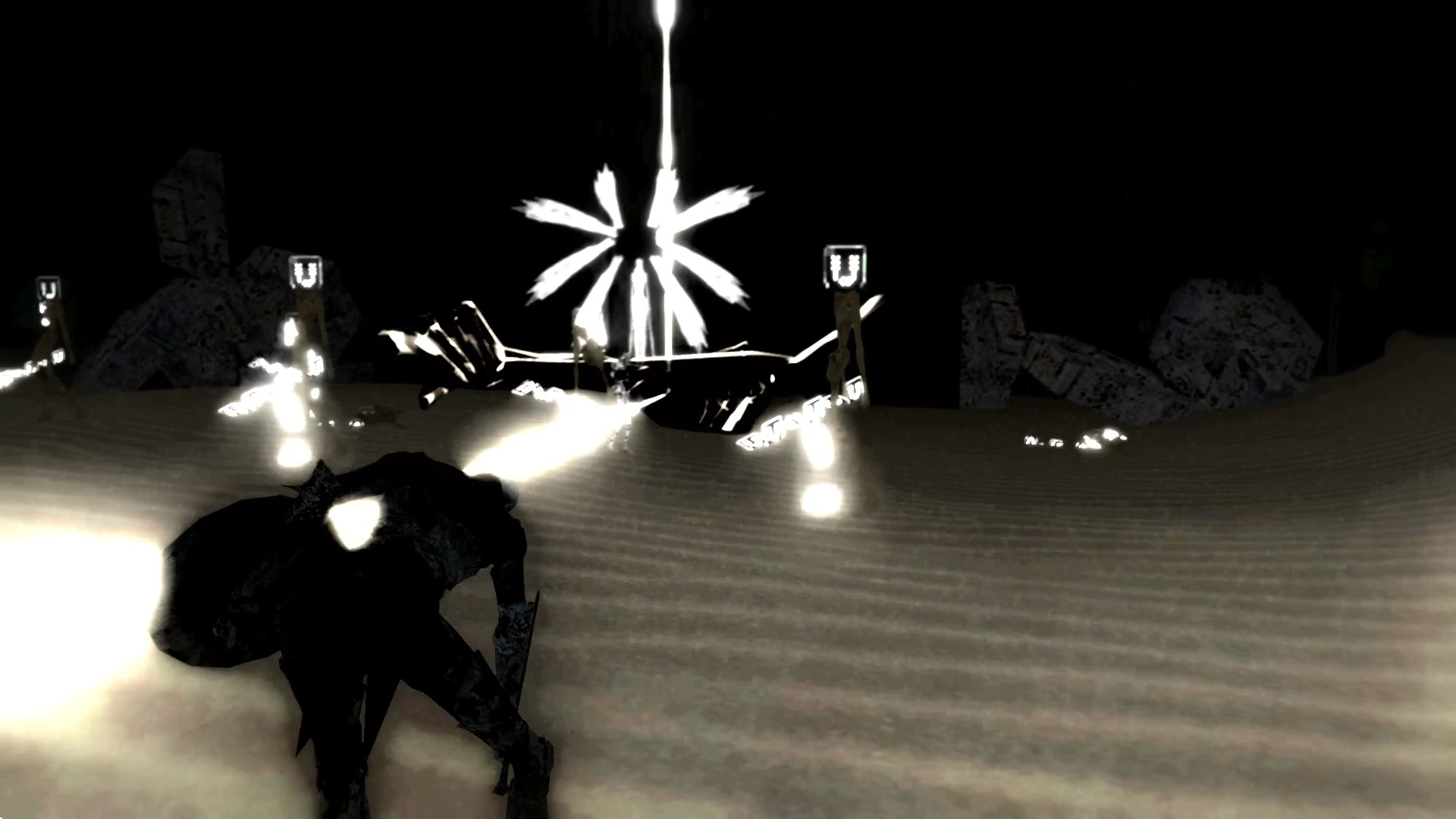
Enjoy the weird gaunt demons that will invade your next few nightmares!
Abyssal Somewhere tells the story of a world in ruin through gameplay and exploration rather than simple exposition. The text prompts that it provides are cryptic and sparse, and at certain points the game seems to intentionally screw with players by prompting one action, but requiring something different. While the game is not particularly challenging, each brief section plays out like a simple puzzle. Solutions are found easily with a little trial and error, and Abyssal Somewhere does a pretty good job of dropping visual breadcrumbs to clue the player in.

Overall, Abyssal Somewhere is a fascinating exercise in alternative gaming. It firmly plants one foot into the world of walking simulators while still adding a healthy amount of player engagement. While Abyssal Somewhere joins the more abstract side of games, experiments like this one are what truly help the medium transcend beyond the usual multiplayer bullet fest or hack-and-slash grind. If you’re looking for a bite sized experience to play this Halloween season that relies on atmosphere to create fear rather than cheap jumpscares, you should consider taking the plunge into Abyssal Somewhere.
You can find Abyssal Somewhere on itch.io for a suggested price of $2.00.
Prefer to watch? Check out this episode of Backlog Quest and some channel news on the 2 Headed Hero YouTube channel.
- Chandon, also known as Bawss Sawss, is a sauce aficionado, gamer, writer, musician, and one head of the 2 Headed Hero gaming channel on YouTube. He can be reached on Twitter, Instagram, or Facebook.
- 2 Headed Hero’s quieter half, Rollinkunz, is the channel’s illustrator, gamer, writer, boardgame designer, He can also be reached on Twitter, Instagram, or Facebook.